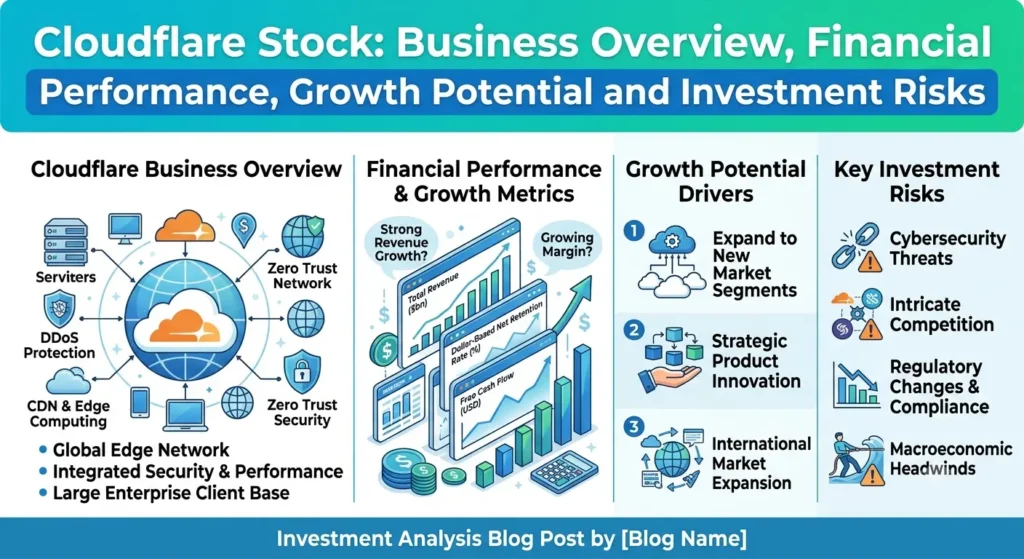
Cloudflare Stock: Business Overview, Financial Performance, Growth Potential and Investment Risks.
Introduction
Technology companies are attracting investor attention as businesses increasingly depend on cloud infrastructure, cybersecurity, artificial intelligence and online applications. One company operating across these areas is Cloudflare, which provides services designed to make websites, applications and networks faster, more reliable and more secure.
Its shares trade on the New York Stock Exchange under the ticker symbol NET. Cloudflare has attracted interest from investors because of its expanding cloud platform, cybersecurity products and potential role in the development of AI-powered applications.
However, strong business growth does not automatically make a stock a good investment at every price. Investors also need to examine revenue, profitability, cash flow, competition and valuation before making a decision.
This article explores Cloudflare’s business model, recent financial performance, growth opportunities, potential risks and important factors to monitor when evaluating Cloudflare stock .
Information in this article is based on publicly available company information and market data available as of 5 November 2026. Cloudflare’s Q3 2026 results are scheduled for release after the US market closes on that date and are not included as reported results.
What Is Cloudflare?
Cloudflare, Inc. is a global cloud services and internet infrastructure company. It provides technology that helps businesses protect websites, improve application performance, manage network traffic and develop digital services.
The company operates a large global network that connects users, applications and online services. Instead of relying entirely on separate infrastructure providers for security, performance and connectivity, organisations can use Cloudflare’s platform to manage several of these requirements.
Its services support customers ranging from small businesses and developers to large enterprises and government organisations.
Cloudflare’s main business areas include:
- Website and application security
- Content delivery and performance optimisation
- Distributed denial-of-service (DDoS) protection
- Web application firewalls
- Zero Trust network security
- Developer tools and serverless computing
- AI-related infrastructure and application services
The company generates revenue by offering free and paid services, subscription plans and enterprise solutions. Its business model gives customers the opportunity to begin with selected products and expand their use of the platform as their requirements grow.
What Does Cloudflare Do?
To understand Cloudflare stock, it is important to understand the services that support the company’s revenue.
1. Website and Application Security
Websites and applications face several online threats, including malicious traffic, automated attacks and attempts to exploit software vulnerabilities.
Cloudflare provides security products that help organisations identify and manage these threats.
Its services include DDoS protection, web application firewalls, bot management and API security. These products help businesses protect their digital infrastructure and reduce the risks associated with online attacks.
As organisations move more operations online, demand for reliable security services can create opportunities for Cloudflare.
2. Content Delivery Network and Performance
A website needs to deliver content quickly to visitors in different locations. Cloudflare uses a distributed network to help deliver content closer to users.
Its content delivery services can reduce latency, improve website performance and help manage traffic during periods of high demand.
These services are useful for e-commerce businesses, media platforms, software companies and other organisations that depend on fast online experiences.
3. Zero Trust Security
Traditional network security often relied on the assumption that users inside an organisation’s network could be trusted.
Zero Trust security takes a different approach. It requires users and devices to be verified before accessing protected applications and resources.
Cloudflare offers Zero Trust products that help businesses manage access, secure internet traffic and protect employees working from different locations.
This area provides another opportunity for the company to sell additional services to enterprise customers.
4. Cloudflare Workers and Developer Tools
Cloudflare Workers is a platform that allows developers to run code across Cloudflare’s global network without managing traditional server infrastructure in the same way.
It supports applications, APIs and other workloads that need to operate close to users.
The developer platform is important because it allows Cloudflare to expand beyond website security and content delivery into application development and computing infrastructure.
5. AI Infrastructure and Services
Artificial intelligence is creating new requirements for computing, application development, data management and security.
Cloudflare is developing products and infrastructure intended to support AI applications and agent-based services.
This opportunity is particularly interesting because businesses may need secure ways to deploy AI applications, manage AI traffic and connect different services.
However, AI-related demand still needs to translate into sustainable revenue and attractive margins before investors can treat it as a proven financial growth driver.
Why Are Investors Interested in Cloudflare Stock?
Cloudflare attracts attention because it operates in several technology markets with long-term growth opportunities.
Rather than depending on a single product category, the company offers services across security, networking, application performance and developer infrastructure.
There are several reasons investors may follow the stock.
Growing Demand for Cybersecurity
Businesses face ongoing risks from cyberattacks, malicious bots, data breaches and vulnerable applications.
As digital operations expand, organisations need stronger protection for their websites, networks and applications.
Cloudflare’s security products position the company to compete for this spending.
Expansion of Cloud Computing
More organisations use cloud-based services to run applications and manage their infrastructure.
This creates demand for services that connect users, secure applications and improve performance.
Cloudflare can benefit when customers expand their use of its platform or adopt additional products.
Artificial Intelligence Opportunities
AI is changing how software is developed and how users interact with online services.
AI applications require infrastructure, security, connectivity and tools for developers. Cloudflare’s existing network and developer platform could help it participate in this market.
The opportunity is attractive, but investors should look for evidence of customer adoption, revenue contribution and profitability rather than relying only on AI-related announcements.
Enterprise Customer Expansion
Large businesses often require multiple security and networking products.
Cloudflare can increase revenue when existing customers purchase more services or move to higher-value enterprise agreements.
This makes customer retention, spending expansion and large-customer growth important indicators to monitor.
Cloudflare Financial Performance: What Do the Numbers Show?
Financial performance is one of the most important parts of stock analysis. Revenue growth can show whether demand is increasing, while margins and cash flow help investors understand the quality of that growth.
Cloudflare’s second-quarter 2026 results provide the latest completed quarterly financial picture available before its scheduled Q3 earnings announcement on 5 November 2026.
Second Quarter 2026 Results
Cloudflare reported revenue of $696.1 million for the quarter ended 30 June 2026, representing 36% year-over-year growth.
Other important financial figures included:
| Financial metric | Q2 2026 result |
|---|---|
| Revenue | $696.1 million |
| Revenue growth | 36% year over year |
| GAAP gross margin | 71.8% |
| Non-GAAP gross margin | 73.1% |
| GAAP operating loss | $205.7 million |
| Non-GAAP operating income | $96.1 million |
| GAAP net loss | $170.0 million |
| Non-GAAP net income | $107.8 million |
| Free cash flow | $56.4 million |
| Cash and available-for-sale securities | $4.16 billion |
These figures show that Cloudflare continued to grow revenue at a strong rate. However, the company also reported a substantial GAAP net loss and lower gross margins compared with the same quarter of the previous year.
The difference between GAAP and non-GAAP results is important. Non-GAAP figures exclude certain expenses and adjustments, so investors should review both sets of numbers rather than relying on adjusted earnings alone.
Revenue Growth
Revenue growth is one of Cloudflare’s strongest reported indicators.
Its second-quarter revenue increased from approximately $512.3 million in Q2 2025 to $696.1 million in Q2 2026.
This growth suggests that demand for the company’s products continued to expand.
However, investors should also consider whether growth is being supported by recurring customer spending, new customer additions and expansion across existing accounts.
Profitability and Margins
Cloudflare’s gross margin deserves attention.
Its non-GAAP gross margin declined from 76.3% in Q2 2025 to 73.1% in Q2 2026. Its GAAP gross margin also declined from 74.9% to 71.8%.
A lower gross margin means the company is retaining a smaller proportion of revenue after accounting for the cost of delivering its services.
Investors should monitor whether infrastructure, network and traffic-related expenses continue to increase faster than revenue.
Cash Flow
Cloudflare generated $56.4 million in free cash flow during Q2 2026, compared with $33.3 million in the same quarter of 2025.
Positive free cash flow is important because it shows that the business can generate cash after accounting for capital expenditure and capitalised internal-use software.
It does not remove the need to examine stock-based compensation, operating expenses and future infrastructure investment.
Cloudflare Q3 2026 Earnings: What Should Investors Watch?
Cloudflare announced that it would report its third-quarter 2026 financial results after the US market closes on 5 November 2026.
Because the results are scheduled for release on that date, they should not be treated as reported financial information in an article prepared before the announcement.
Based on the company’s Q2 guidance, investors can use the following figures as expectations rather than confirmed results.
| Q3 2026 guidance | Company expectation |
|---|---|
| Revenue | $736–$737 million |
| Non-GAAP operating income | $129–$130 million |
| Non-GAAP diluted EPS | $0.34 |
The company also provided full-year 2026 guidance in its Q2 earnings release:
- Revenue: $2.864–$2.870 billion
- Non-GAAP operating income: $443–$445 million
- Non-GAAP diluted EPS: $1.25–$1.26
These are management forecasts, not guaranteed outcomes.
When the Q3 report becomes available, investors should compare actual results with guidance and examine whether management changes its full-year outlook.
Important areas to watch include revenue growth, gross margin, operating expenses, customer expansion, cash flow and commentary about AI-related demand.
Cloudflare Stock Valuation: Is NET Expensive?
A growing business is not automatically an attractive investment. The price investors pay for future growth is equally important.
Cloudflare has often traded at a premium valuation compared with many established software and infrastructure companies.
Market data available around 4 November 2026 showed a market capitalisation of approximately $95 billion and a trailing price-to-sales ratio of roughly 39 times. These are market snapshots, not fixed company characteristics, and they can change with the share price and financial results.
A high price-to-sales multiple means investors are paying a substantial amount for each dollar of current revenue.
Why Valuation Matters
Cloudflare’s valuation reflects expectations about future growth, profitability and its position in the technology market.
If the company continues to grow rapidly and improves its margins, investors may consider a premium valuation more reasonable.
However, if revenue growth slows or profitability disappoints, the market may reduce the multiple it is willing to pay.
This can cause the share price to decline even when the company continues to increase revenue.
What Should Investors Compare?
When evaluating NET stock, consider:
- Price-to-sales ratio compared with relevant competitors
- Revenue growth over several quarters
- GAAP and non-GAAP operating margins
- Free cash flow generation
- Stock-based compensation and share dilution
- Forward earnings expectations
- Management’s full-year guidance
No single valuation ratio can determine whether Cloudflare stock is cheap or expensive. A more complete analysis should consider the company’s growth, financial position and competitive environment.
Cloudflare Stock Growth Opportunities
Cloudflare has several potential growth drivers that investors may want to follow over the coming years.
1. AI Adoption
AI applications require computing resources, networking, security and developer tools.
Cloudflare’s existing infrastructure and Workers platform may allow the company to support developers and businesses building AI-powered applications.
If customers adopt more AI-related services and pay for them at scale, this could create an additional source of revenue.
2. Cybersecurity Spending
Cybersecurity remains an important requirement for businesses that depend on online services.
Cloudflare can benefit if organisations increase spending on application security, bot management, Zero Trust and related products.
Its opportunity also includes customers that want to consolidate multiple security services under one platform.
3. Developer Platform Expansion
Cloudflare Workers and its wider developer ecosystem allow the company to serve customers beyond traditional website security.
As more developers build applications on its infrastructure, Cloudflare may have opportunities to sell additional services.
The key question is whether developer adoption translates into recurring customer revenue.
4. International Market Opportunities
Cloudflare serves organisations across different regions and industries.
Continued adoption of cloud services and cybersecurity solutions outside the United States could support its expansion.
However, international operations also introduce currency, regulatory, geopolitical and market-specific risks.
5. Larger Enterprise Customers
Large customers can represent meaningful revenue opportunities because they often require multiple products and larger service agreements.
Cloudflare’s ability to attract enterprise accounts and expand existing relationships could support long-term revenue growth.
Investors should monitor large-customer additions and customer spending trends in future earnings reports.
Risks of Investing in Cloudflare Stock
Cloudflare has attractive business opportunities, but investors should also understand the risks.
1. High Stock Valuation
One of the most important risks is valuation.
When a stock trades at a high revenue multiple, investors may already expect substantial future growth.
If Cloudflare fails to meet market expectations, the share price could fall sharply.
2. GAAP Losses
Cloudflare reported a GAAP net loss of $170 million in Q2 2026.
Although it generated positive non-GAAP income and free cash flow, investors should continue monitoring its progress towards sustainable GAAP profitability.
Stock-based compensation and other operating expenses are important parts of this analysis.
3. Competitive Pressure
Cloudflare operates in markets with established technology companies and specialised competitors.
Its competitors include businesses offering cloud infrastructure, application security, content delivery and enterprise network protection.
Competition may affect pricing, customer acquisition costs and the company’s ability to maintain margins.
4. Infrastructure Costs
Cloudflare relies on a large global network to deliver its services.
Operating and expanding this infrastructure requires investment. If network and traffic-related costs increase faster than revenue, gross margins could face further pressure.
This is especially important as the company handles more demanding workloads.
5. Technology and Cybersecurity Risks
Cloudflare’s business depends on the reliability and security of its network and systems.
Major service disruptions, security incidents or technical failures could affect customer confidence and business operations.
The company also needs to keep improving its products as online threats and technology requirements change.
6. Market Volatility
Technology growth stocks can experience significant price movements.
Interest rates, investor sentiment, economic conditions and changes in expectations about AI-related companies can influence Cloudflare’s share price.
Even positive company results may not prevent a stock decline if investors were expecting stronger performance.
Cloudflare Stock vs Other Technology Stocks
Investors may compare Cloudflare with other companies operating in cloud infrastructure, cybersecurity and application delivery.
Some commonly considered companies include:
- Akamai Technologies: Provides content delivery, cloud computing and cybersecurity services.
- Zscaler: Focuses on cloud-based security and Zero Trust solutions.
- Fastly: Provides edge cloud services, content delivery and application security.
- F5: Offers application delivery and security solutions.
- Palo Alto Networks: Operates across enterprise cybersecurity and network security.
These companies do not have identical business models. Some focus more heavily on cybersecurity, while others have broader infrastructure or application delivery businesses.
A useful comparison should examine revenue growth, operating margins, cash flow, customer retention, product mix and valuation.
The goal is not simply to identify the company with the fastest revenue growth. Investors should understand how efficiently each business converts that growth into cash and long-term profitability.
How to Analyse Cloudflare Stock Before Investing
Investors can use a structured approach rather than relying on stock predictions or short-term price movements.
Step 1: Understand the Business
Learn how Cloudflare makes money and which products contribute to its growth.
Pay attention to its security services, developer tools, enterprise products and AI-related opportunities.
Step 2: Review Financial Statements
Read the company’s quarterly earnings releases, annual reports and SEC filings.
Focus on revenue, gross margin, operating income, net income, cash flow and balance-sheet strength.
Step 3: Examine Valuation
Compare the company’s valuation with its growth rate, profitability and relevant competitors.
A high valuation requires strong future performance to justify investor expectations.
Step 4: Review Management Guidance
Compare actual results with management’s previous forecasts.
Look for changes in revenue expectations, operating margin targets and commentary about customer demand.
Step 5: Understand Your Risk Tolerance
Growth stocks can experience large price fluctuations.
Consider your investment timeframe, portfolio diversification and ability to tolerate losses before deciding whether a stock is suitable for you.
Is Cloudflare Stock a Buy, Sell or Hold?
There is no single answer that applies to every investor.
Cloudflare has several characteristics that may attract long-term growth investors: strong reported revenue growth, a broad cloud and security platform, positive free cash flow and potential opportunities connected with AI and developer infrastructure.
At the same time, its GAAP losses, declining year-over-year gross margins, competitive environment and premium valuation create risks that should not be ignored.
A long-term investor may focus on whether Cloudflare can maintain revenue growth while improving profitability. A valuation-focused investor may prefer to wait for a more attractive entry price or clearer evidence of margin improvement.
Short-term traders may pay more attention to earnings announcements, market sentiment and technical price movements.
Rather than relying on a simple buy, sell or hold label, investors should assess the company’s financial progress and stock valuation against their own investment objectives.
Conclusion
Cloudflare is an important company to follow in the cloud infrastructure and cybersecurity markets. Its services support website performance, application security, enterprise connectivity and developer tools. Its expanding platform also gives it opportunities to participate in the growth of AI-powered applications.
The company’s Q2 2026 results showed 36% year-over-year revenue growth and positive free cash flow. However, GAAP losses and lower gross margins highlight why investors should examine profitability alongside revenue expansion.
Cloudflare’s future performance will depend on its ability to attract customers, expand product adoption, manage infrastructure costs and convert growth opportunities into sustainable earnings and cash flow.
For investors researching Cloudflare stock the most useful approach is to review updated financial results, compare valuation with business performance and understand the risks before making an investment decision.
What does Cloudflare do?
Cloudflare provides cloud-based services covering website security, content delivery, application performance, network connectivity, Zero Trust security and developer infrastructure.
Is Cloudflare a profitable company?
Cloudflare reported positive non-GAAP net income of $107.8 million in Q2 2026, but it also reported a GAAP net loss of $170 million. Investors should distinguish between adjusted and GAAP profitability when evaluating its financial performance.
Why is Cloudflare stock popular with growth investors?
Investors follow Cloudflare because of its exposure to cybersecurity, cloud infrastructure, developer tools and AI-related services. Its revenue growth and potential enterprise expansion are also important considerations.
Does Cloudflare benefit from artificial intelligence?
Cloudflare may benefit from AI adoption through demand for infrastructure, security and developer services. However, investors should monitor how much AI-related activity translates into paying customers and recurring revenue.
When is Cloudflare's Q3 2026 earnings report?
Cloudflare scheduled its Q3 2026 earnings announcement for after the US market closes on 5 November 2026. The reported results should be checked through the company’s investor relations website after publication.