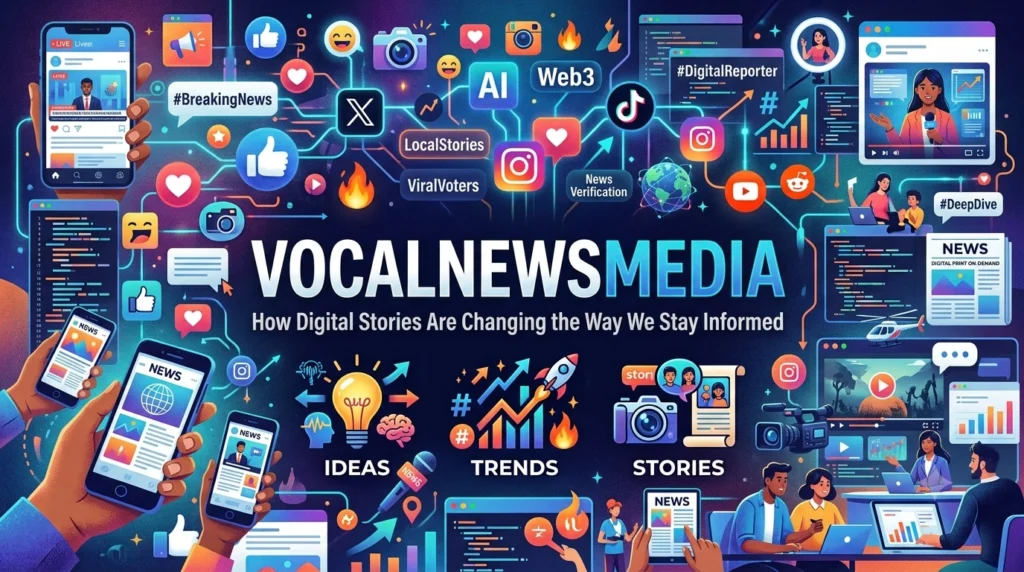
VocalNewsMedia: How Digital Stories Are Changing the Way We Stay Informed.
Introduction
The way people stay informed has changed dramatically.
A few years ago, many people depended mainly on newspapers, television broadcasts, magazines, or radio for their daily information. Today, the process is far more immediate. A person can discover a developing story through a search engine, see reactions on social media, watch a video explanation, and read a detailed article—all within minutes.
This shift has created a constantly moving digital information environment.
VocalNewsMedia represents this broader landscape of online publishing, where digital stories, news, technology, lifestyle subjects, business developments, and emerging trends can reach audiences across multiple channels.
The real value of modern digital media, however, isn’t simply speed. It comes from helping people understand what happened, why it matters, and how it may affect them.
What Is VocalNewsMedia?
VocalNewsMedia can be viewed as a digital media and publishing concept centered around online stories, news, trends, and informative content.
A platform in this space can cover a wide range of subjects, including:
- Technology
- Artificial intelligence
- Business
- Finance
- Lifestyle
- Entertainment
- Education
- Travel
- Sports
- Social media
- Digital culture
- Internet trends
This broad approach reflects the way people consume information today. Readers rarely limit themselves to one category. Their interests can move from technology to business, entertainment to lifestyle, or current events to practical guides.
Why Digital Stories Matter
Digital stories have become an important part of everyday information discovery.
People use online content to:
- Understand current developments
- Learn about new technologies
- Research products and services
- Follow industries
- Discover trends
- Learn practical skills
- Explore entertainment
- Compare different viewpoints
Because information is available almost instantly, readers now have more control over what they consume.
At the same time, they also have more responsibility to evaluate what they see.
1. Information Moves Faster Than Ever
Digital publishing has removed many of the limitations associated with traditional publishing schedules.
An online story can be published and updated as new details become available.
This is particularly useful for developing subjects.
However, speed can also create problems when incomplete information is presented as a finished story.
A responsible digital reader should understand that early reports may change.
2. Headlines Are Only the Beginning
A headline is designed to capture attention.
But it rarely contains the full story.
Readers may need to know:
- What actually happened?
- Who is involved?
- Why did it happen?
- What evidence is available?
- What could happen next?
This is why detailed reporting, explainers, and background articles remain valuable.
3. Context Makes Information More Useful
Imagine reading that a major technology company has launched a new AI product.
The announcement itself is information.
But readers may also want to know:
- What the product does
- Who can use it
- How it compares with existing tools
- Why the company introduced it
- What limitations it has
- What impact it could have
Context transforms a basic update into something easier to understand.
VocalNewsMedia and Technology Coverage
Technology has become one of the most influential subjects in digital publishing.
4. Technology Is Part of Everyday Life
Technology influences many ordinary activities.
People use digital tools for:
- Communication
- Education
- Shopping
- Banking
- Work
- Entertainment
- Travel
- Personal organization
As a result, technology news isn’t limited to software developers or IT professionals.
Almost everyone can be affected by technological change.
5. Artificial Intelligence Is Reshaping Digital Conversations
Artificial intelligence has become a major area of interest.
People are increasingly searching for information about:
- Generative AI
- AI assistants
- AI search
- Automation
- AI productivity
- AI in business
- AI content creation
- AI-powered applications
The challenge for digital publishers is to explain these subjects in ways that are understandable to both beginners and experienced readers.
6. Practical Explanations Can Make Technology Easier
Technical subjects can become confusing when they rely heavily on specialized terminology.
A better approach is often to answer simple questions:
What is it?
How does it work?
Who can use it?
Why does it matter?
What are its limitations?
This structure helps readers connect technology with practical situations.
VocalNewsMedia and Business Information
Business developments can influence customers, employees, entrepreneurs, and entire industries.
7. Business Stories Need More Than Announcements
Suppose a company launches a new service.
A basic article might simply announce the launch.
A more useful article can explain:
- What changed
- Why the company made the change
- Who can use the service
- What customers should know
- How competitors may respond
- What the development could mean for the industry
Readers gain much more value from this additional context.
8. Business Terminology Should Be Explained
Terms such as:
- Revenue
- Market share
- Acquisition
- Valuation
- Subscription model
- Digital transformation
may be obvious to professionals but unfamiliar to general readers.
Clear explanations make business content more accessible.
VocalNewsMedia and Lifestyle Stories
Digital media isn’t only about breaking news.
People also search for information that helps them make everyday decisions.
9. Practical Lifestyle Content Has Long-Term Value
Lifestyle topics can include:
- Travel
- Food
- Home organization
- Productivity
- Entertainment
- Hobbies
- Personal planning
- Consumer trends
The most useful articles usually solve a recognizable problem or answer a specific question.
10. Evergreen Articles Can Remain Useful
Some topics don’t disappear after a single news cycle.
Examples include:
- Beginner guides
- How-to articles
- Definitions
- Checklists
- Educational resources
- Practical tutorials
These types of pages can continue helping readers long after publication.
Search and the New Information Journey
Search engines have changed how people discover content.
11. Readers Often Start With a Question
Instead of opening a particular publication first, people may type a question into a search engine.
For example:
“What is generative AI?”
“How does digital media work?”
“What are the latest technology trends?”
“How can I improve my online productivity?”
Each query represents a different information need.
12. Search Intent Should Guide Content
Understanding search intent helps publishers create more relevant articles.
Informational Intent
The reader wants to learn.
Navigational Intent
The reader wants to find a specific website or brand.
Commercial Research
The reader is comparing choices.
Practical Intent
The reader wants to complete a task.
A successful article addresses the reason behind the search rather than simply repeating keywords.
13. Direct Answers Improve Reader Experience
A useful article can begin with a concise answer before expanding into details.
A simple structure is:
Answer → Explanation → Examples → Context → Related questions
This allows readers who want a quick response to find it while still providing depth for those who want to continue reading.
VocalNewsMedia and Social Media
Social platforms have become major sources of information discovery.
14. Social Media Can Introduce a Story
A reader might first encounter a story through:
- A short video
- A social post
- A shared article
- A trending topic
- An online community
- A recommendation
The social post becomes the entry point, while the full article provides greater context.
15. Digital Publishing Has Become Interactive
Readers aren’t passive anymore.
They can:
- Comment
- Ask questions
- Share stories
- Challenge information
- Offer experiences
- Recommend resources
This creates a two-way relationship between publishers and audiences.
16. Viral Content Isn’t Automatically Reliable
A story can become popular because it is surprising or emotional.
Popularity doesn’t prove accuracy.
Readers should be especially careful with claims involving:
- Health
- Finance
- Politics
- Technology
- Business
- Breaking events
Important information should be checked against reliable sources.
The Importance of Digital Literacy
Having access to information doesn’t automatically mean understanding it.
17. Check the Date
Online information can become outdated.
This is especially important for subjects such as:
- Software
- Technology
- Travel
- Business
- Finance
- Current events
Always look at the publication or update date when it matters.
18. Examine the Source
Before trusting an important claim, ask:
- Who published it?
- Does the source have relevant expertise?
- Are supporting sources provided?
- Is the information presented transparently?
Source awareness is an important part of digital literacy.
19. Compare Important Claims
For significant stories, reading more than one reputable source can provide a clearer picture.
Different sources may highlight different aspects of the same event.
Comparing them can reveal additional context or areas of uncertainty.
20. Separate Facts From Interpretation
Not every statement in an article serves the same purpose.
Some are:
- Verified facts
- Analysis
- Predictions
- Opinions
- Commentary
Recognizing the difference helps readers interpret information more carefully.
VocalNewsMedia and Mobile Content
Much of today’s online reading happens on smartphones.
21. Make Content Easy to Scan
Mobile readers benefit from:
- Short paragraphs
- Clear headings
- Bullet points
- Simple sentences
- Descriptive subheadings
- Useful visuals
A well-structured article lets readers quickly locate the information they need.
22. Avoid Unnecessary Complexity
Online readers shouldn’t need specialist knowledge to understand a basic explanation.
Simple language doesn’t mean shallow content.
It means communicating an idea clearly.
Technical terminology should be used when necessary and explained when appropriate.
The Role of Visual Content
Modern digital publishing increasingly combines text with visuals.
23. Images Can Provide Context
A relevant image can help readers understand:
- A person
- A place
- A product
- An event
- A technology
- A concept
Visuals can also make longer articles easier to navigate.
24. Infographics Can Simplify Data
Infographics can be useful for:
- Statistics
- Comparisons
- Timelines
- Processes
- Trends
They allow readers to absorb structured information quickly.
25. Video Can Explain Demonstrations
Some subjects are easier to see than read about.
Video works particularly well for:
- Tutorials
- Interviews
- Demonstrations
- Product walkthroughs
- Educational explanations
A combination of formats can make information accessible to different audiences.
VocalNewsMedia and AI-Assisted Content
Artificial intelligence is changing the publishing workflow itself.
26. AI Can Support Content Production
AI can help with tasks such as:
- Brainstorming
- Organizing research
- Creating outlines
- Summarizing information
- Translating content
- Repurposing articles
- Identifying related topics
These tools can improve efficiency.
27. Human Verification Remains Essential
AI-generated material may contain:
- Incorrect facts
- Outdated information
- Missing context
- Overconfident statements
Human review remains important, particularly when content involves factual claims.
28. Technology Should Support Editorial Quality
The purpose of using AI shouldn’t simply be producing more content.
The goal should be producing better content more efficiently.
That means technology should support:
- Research
- Clarity
- Organization
- Accessibility
- Personalization
Human judgment should remain part of the process.
Building a Strong Digital Publishing Strategy
A consistent process can help publishers maintain quality.
Step 1: Identify the Audience
Understand who the content is designed for.
Step 2: Find the Information Need
Determine what question the audience wants answered.
Step 3: Research the Subject
Use trustworthy information.
Step 4: Create a Clear Outline
Organize the article logically.
Step 5: Give the Main Answer
Don’t hide the key information.
Step 6: Add Context
Explain why the subject matters.
Step 7: Include Examples
Make the information practical.
Step 8: Optimize the Reading Experience
Use headings, lists, tables, and visuals where useful.
Step 9: Verify Important Details
Check names, dates, statistics, and claims.
Step 10: Update Valuable Content
Review older articles when information changes.
Combining Current and Evergreen Content
A strong digital publication doesn’t have to choose between timely stories and long-term resources.
It can use both.
| Content Type | Main Benefit |
|---|---|
| Breaking news | Immediate awareness |
| Trend analysis | Broader understanding |
| Explainer | Simplifies complex topics |
| Guide | Provides practical value |
| FAQ | Answers direct questions |
| Evergreen article | Long-term usefulness |
This combination creates a more complete information ecosystem.
Measuring Content Success
Traffic is useful, but it isn’t the only measure of success.
Publishers can monitor:
- Organic traffic
- Page views
- Engagement time
- Returning visitors
- Social shares
- Comments
- Newsletter subscriptions
- Conversions
The right metric depends on the purpose of the content.
An educational article may succeed by helping readers understand a subject, while a commercial page may be measured by conversions.
Common Digital Media Mistakes
Chasing Every Trending Topic
Not every trend is relevant to every audience.
Using Sensational Headlines
Attention without substance can damage credibility.
Publishing Unverified Information
Speed should never replace accuracy.
Ignoring Search Intent
An article can rank for keywords and still fail to answer the reader’s actual question.
Making Articles Difficult to Scan
Large blocks of text can discourage mobile readers.
Forgetting to Update Old Content
Outdated information can reduce reader trust.
10 Principles for Better Digital Publishing
- Understand the reader before creating content.
- Start with a clear information need.
- Give direct answers.
- Provide meaningful context.
- Use practical examples.
- Verify important claims.
- Make content easy to scan.
- Combine text with useful visual formats.
- Use AI responsibly and review its output.
- Build long-term trust instead of chasing short-term clicks.
Frequently Asked Questions
What is VocalNewsMedia?
VocalNewsMedia can be understood as a digital media and publishing concept focused on online news, stories, trends, technology, and informative content.
What subjects can VocalNewsMedia cover?
A broad digital media platform can cover technology, AI, business, finance, lifestyle, entertainment, education, travel, sports, social media, and emerging internet trends.
Why is context important in online news?
Context helps readers understand not only what happened but also why it happened, who may be affected, and what the development could mean.
How can readers check online information?
Readers can examine the source, publication date, supporting evidence, and relevant context. Important claims should be compared with reputable sources when appropriate.
What is evergreen digital content?
Evergreen content remains useful over a long period because it answers recurring questions through guides, tutorials, definitions, checklists, or educational resources.
How can AI help digital publishers?
AI can assist with research organization, brainstorming, outlining, summarization, translation, and content repurposing, while human review helps maintain accuracy and quality.
Conclusion
VocalNewsMedia reflects a new era of information discovery in which digital stories can reach audiences faster and through more channels than ever before.
The modern reader has enormous access to information, but access alone isn’t enough.
People need content that helps them understand what they’re seeing.
That means digital publishers have an important role to play.
They can provide timely stories, useful explainers, practical guides, technology coverage, business information, lifestyle content, and broader context.
Search can make these resources discoverable.
Social media can help them travel.
Video and visuals can make them easier to understand.
Artificial intelligence can support the publishing workflow.
But the most important ingredients remain accuracy, relevance, clarity, and trust.
As the digital information environment continues to evolve, platforms such as VocalNewsMedia can create meaningful value by helping readers move beyond simply seeing information toward actually understanding it.
In a world filled with content, the information that explains, informs, and genuinely helps people will always have a reason to be read.