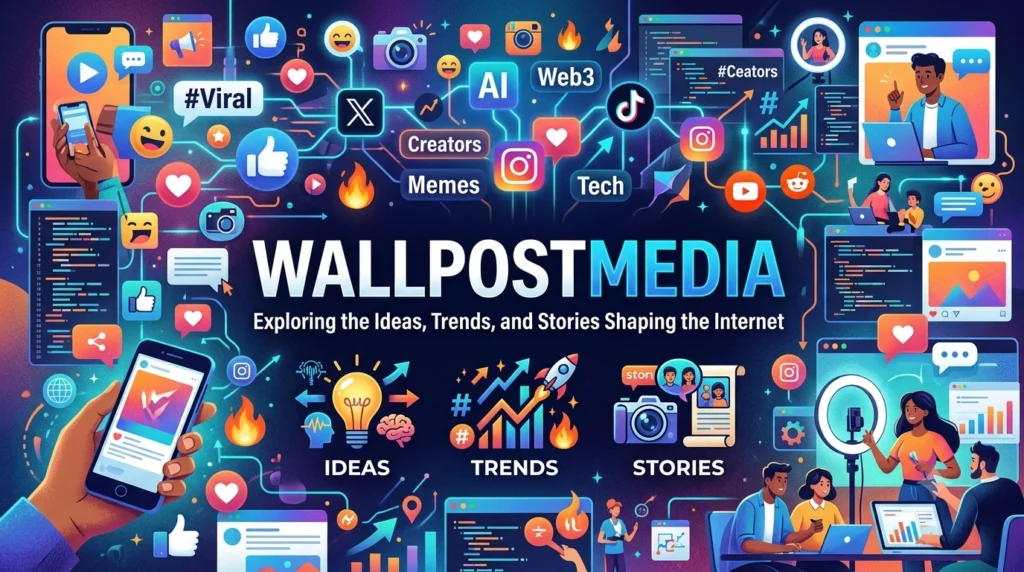
Wallpostmedia: Exploring the Ideas, Trends, and Stories Shaping the Internet.
Introduction
The internet has become much more than a place to search for information.
It is where people discover new ideas, follow breaking developments, compare opinions, learn skills, explore entertainment, communicate with businesses, and participate in communities. Every day, millions of pieces of content compete for attention across websites, search engines, social networks, video platforms, newsletters, and online forums.
This constantly changing environment has created a new kind of media experience.
Wallpostmedia represents the broader world of digital publishing, where stories, ideas, trends, technology, and online conversations can come together to serve modern audiences.
The challenge isn’t simply producing content. The real challenge is creating information that is useful enough to earn attention and valuable enough to be remembered.
What Is Wallpostmedia?
Wallpostmedia can be viewed as a digital media and publishing concept focused on online stories, ideas, trends, and audience-focused content.
A platform working within this space can explore subjects such as:
- Technology
- Artificial intelligence
- Business
- Digital marketing
- Lifestyle
- Entertainment
- Education
- Social media
- Online culture
- Emerging internet trends
The subjects may change as audience interests evolve, but the central idea remains consistent: bring useful digital information to people in an accessible format.
Why Digital Media Matters Today
Digital media has changed how people interact with information.
A person can now discover an idea through a social post, research it through search, watch a video about it, read a detailed article, and discuss it with others—all within a short period.
This creates several important advantages.
Faster Discovery
New information can reach audiences almost immediately.
Greater Accessibility
People can access content from computers, tablets, and smartphones.
More Perspectives
Readers can compare different viewpoints and sources.
Greater Participation
Audiences can comment, share, question, and contribute.
1. Online Publishing Has Become More Flexible
Traditional publishing often depended on fixed schedules and physical distribution.
Digital publishing offers much greater flexibility.
Content can be:
- Published instantly
- Updated later
- Shared across platforms
- Expanded with additional information
- Connected to related articles
- Supported with video and images
This makes online publishing particularly useful for both timely and educational content.
2. Readers Have More Choices
The modern reader can choose from thousands of websites and content creators.
That creates an important challenge for publishers.
Why should someone read one article instead of another?
The answer often comes down to:
- Relevance
- Accuracy
- Clarity
- Originality
- Presentation
- Usefulness
More content does not automatically create more value.
3. Attention Must Be Earned
A headline may earn a click.
But useful content earns trust.
Readers are more likely to return when a publication consistently helps them:
- Understand something
- Solve a problem
- Discover an idea
- Make a decision
- Stay informed
Long-term audience relationships are built through repeated value.
Wallpostmedia and Digital Storytelling
Storytelling remains powerful even when the medium changes.
4. Every Story Needs a Clear Purpose
Before publishing content, identify its main purpose.
An article might aim to:
- Explain a concept
- Report an event
- Explore a trend
- Answer a question
- Provide practical advice
- Compare different options
A clear purpose keeps the article focused.
5. Context Turns Information Into Understanding
Consider a technology announcement.
A basic article may explain what was launched.
A stronger article can also explain:
- Why it was launched
- What problem it addresses
- Who might use it
- How it compares with existing options
- What its limitations are
- What could happen next
Context gives readers a fuller picture.
6. Examples Make Digital Stories More Relatable
Complex subjects often become easier when connected to everyday situations.
For example, instead of discussing automation only through technical terminology, an article could show how a small business might use automation to organize repetitive tasks.
The example gives the reader something concrete to understand.
Wallpostmedia and Technology Trends
Technology continues to influence almost every part of digital life.
7. Technology Is No Longer a Niche Subject
Technology affects:
- Communication
- Education
- Employment
- Shopping
- Entertainment
- Transportation
- Business
- Personal productivity
As a result, technology stories are increasingly relevant to general audiences.
8. Artificial Intelligence Is Reshaping Digital Experiences
Artificial intelligence has become one of the most discussed areas of technology.
People are exploring:
- Generative AI
- AI assistants
- AI search
- Automation
- AI-powered applications
- AI in business
- AI content creation
- AI productivity tools
The challenge is making these subjects understandable without unnecessary technical complexity.
9. Practical Technology Content Has Strong Value
Readers often want to know more than what a new technology does.
They want to understand:
How could this affect me?
Practical explanations can connect technological developments with everyday experiences.
Wallpostmedia and Social Media
Social platforms have become important parts of the digital publishing ecosystem.
10. Social Media Is a Discovery Tool
People often encounter stories through:
- Short posts
- Videos
- Shares
- Recommendations
- Trending discussions
- Online communities
A social platform may introduce a subject before the reader visits the original article.
11. Content Can Become a Conversation
Digital audiences can respond immediately.
They may:
- Ask questions
- Share experiences
- Challenge claims
- Recommend additional resources
- Share articles with friends
- Create follow-up content
This creates a two-way relationship between publishers and audiences.
12. Different Formats Serve Different Purposes
A detailed article doesn’t have to remain a single piece of content.
It can be transformed into:
| Format | Purpose |
|---|---|
| Article | Detailed information |
| Short post | Quick takeaway |
| Video | Demonstration |
| Infographic | Visual summary |
| Newsletter | Curated information |
| FAQ | Direct answers |
This approach can help one idea reach different audience preferences.
Wallpostmedia and Search Discovery
Search remains an important gateway to digital information.
13. Search Intent Matters
A person searching online may have very different goals.
Informational
“What is digital publishing?”
The user wants an explanation.
Navigational
“Wallpostmedia”
The user wants to find a particular website or brand.
Research-Based
“Best digital publishing strategies”
The user wants to compare or learn.
Practical
“How to create an online article”
The user wants instructions.
Content becomes more useful when it matches the underlying intent.
14. Answer Questions Before Adding Complexity
Readers shouldn’t have to search through an article for the basic answer.
A strong structure is:
Direct answer → Explanation → Example → Deeper context
This approach supports both quick readers and people who want more detail.
15. Use Related Content to Expand Understanding
One article cannot always answer every question.
Instead, related articles can provide deeper information.
For example:
Digital Media Topic Cluster
- What is digital publishing?
- How online content is created
- Social media distribution
- Search and content discovery
- Visual storytelling
- Digital audience engagement
This creates a connected library of information.
Wallpostmedia and AI-Assisted Publishing
Artificial intelligence is also influencing how digital content is produced.
16. AI Can Help With Repetitive Tasks
AI tools can assist with:
- Brainstorming
- Research organization
- Summarization
- Translation
- Content outlines
- Data organization
- Content repurposing
These capabilities can help publishers work more efficiently.
17. Human Judgment Remains Important
AI-generated information can sometimes contain:
- Factual errors
- Outdated information
- Missing context
- Repetitive explanations
Human review is therefore important before publishing content that readers may rely on.
Technology can improve efficiency, but editorial judgment remains valuable.
18. Originality Still Matters
Generating content quickly doesn’t guarantee that it will be interesting.
Strong content needs:
- A clear point of view
- Useful examples
- Audience understanding
- Relevant context
- Meaningful insights
AI can support the workflow, but the value ultimately comes from what the content provides to the reader.
Wallpostmedia and Visual Communication
People don’t consume digital information through text alone.
19. Images Can Strengthen an Article
Relevant images can help:
- Introduce a subject
- Explain an idea
- Provide visual context
- Break up long sections
- Improve navigation
The image should support the information rather than simply decorate the page.
20. Infographics Can Simplify Complex Information
Infographics can combine:
- Statistics
- Comparisons
- Timelines
- Processes
- Short explanations
This can make complicated information easier to scan.
21. Video Can Demonstrate Ideas
Video is particularly useful when showing something is easier than describing it.
Common uses include:
- Tutorials
- Interviews
- Demonstrations
- Product walkthroughs
- Educational explanations
A combination of text and video can serve different learning preferences.
Building Trust in Digital Publishing
The abundance of online information makes credibility increasingly important.
22. Verify Important Claims
Before publishing significant information, verify:
- Dates
- Numbers
- Names
- Quotes
- Technical details
- Business information
- Current developments
Accuracy should come before publishing speed.
23. Distinguish Information From Opinion
Readers should understand whether they are consuming:
- News
- Analysis
- Opinion
- Review
- Commentary
- Sponsored content
- Educational material
Clear labeling improves transparency.
24. Correct Errors When Necessary
Even careful publishers can make mistakes.
When meaningful errors are discovered, correcting them helps protect audience trust.
A strong publication should value accuracy over pretending that mistakes never happen.
Wallpostmedia and Evergreen Content
Not all valuable content needs to be tied to a current event.
25. What Makes Content Evergreen?
Evergreen content answers questions that people are likely to continue asking.
Examples include:
- Beginner guides
- Definitions
- Tutorials
- Checklists
- How-to articles
- Educational resources
Such content can continue attracting readers long after its original publication.
26. Evergreen Doesn’t Mean Never Updating
Information can change.
Technology develops. Tools change. Statistics become outdated. Services introduce new features.
Useful evergreen content should therefore be reviewed periodically.
27. Combine Evergreen Resources With Trending Stories
A current story can capture attention.
An evergreen article can provide background.
For example:
Trending story: A major new AI development.
Evergreen resource: A beginner’s guide to understanding generative AI.
Together, the two pieces provide both current relevance and foundational knowledge.
A Practical Wallpostmedia Publishing Process
A repeatable process can improve content quality and consistency.
Step 1: Identify the Audience
Determine who needs the information.
Step 2: Find a Genuine Question
Focus on what people actually want to understand.
Step 3: Research
Gather reliable information and supporting details.
Step 4: Define the Main Takeaway
Decide what readers should remember.
Step 5: Build the Outline
Create logical sections before writing.
Step 6: Write Clearly
Use simple language and direct explanations.
Step 7: Add Context and Examples
Help readers understand why the information matters.
Step 8: Add Supporting Media
Use images, videos, charts, or infographics when appropriate.
Step 9: Review
Check accuracy, readability, grammar, and structure.
Step 10: Publish and Improve
Monitor performance and update the content when necessary.
Measuring Digital Content Performance
Content performance should be evaluated against its purpose.
| Metric | What It Indicates |
|---|---|
| Impressions | Visibility |
| Clicks | Initial interest |
| Organic traffic | Search discovery |
| Engagement time | Reader attention |
| Shares | Content resonance |
| Comments | Audience discussion |
| Returning visitors | Loyalty |
| Conversions | Desired actions |
A page with fewer visitors can sometimes create more value than one with high traffic but little engagement.
Common Digital Publishing Mistakes
Publishing Without a Clear Audience
Content becomes weaker when it tries to appeal to everyone.
Chasing Every Trend
Popularity doesn’t necessarily mean relevance.
Using Misleading Headlines
Short-term clicks can damage long-term credibility.
Writing Without Context
Readers need to understand why information matters.
Overusing Keywords
Natural writing is more useful than repetitive keyword placement.
Ignoring Mobile Readers
Content needs to work well on smaller screens.
Forgetting Older Content
Outdated information can reduce the value of a website.
10 Wallpostmedia Principles for Better Online Content
- Know your audience before choosing a topic.
- Start with a genuine information need.
- Give every article a clear purpose.
- Answer important questions directly.
- Use examples to make ideas practical.
- Add context rather than repeating facts.
- Adapt content to different formats.
- Verify important information.
- Update valuable evergreen resources.
- Build trust through consistent quality.
Frequently Asked Questions
What is Wallpostmedia?
Wallpostmedia can be understood as a digital media and publishing concept focused on online stories, ideas, trends, technology, and audience-focused content.
What topics can Wallpostmedia cover?
A digital media platform can cover technology, artificial intelligence, business, lifestyle, entertainment, education, social media, digital marketing, and emerging online trends.
Why is context important in digital content?
Context helps readers understand why something happened, what it means, who may be affected, and how it connects to broader developments.
How does social media support digital publishing?
Social media can help distribute stories, introduce new audiences to articles, encourage discussions, and transform long-form content into shorter formats.
What is evergreen content?
Evergreen content provides information that remains useful over time, including guides, tutorials, definitions, checklists, and educational resources.
Can AI improve digital publishing?
AI can assist with brainstorming, research organization, summarization, and content repurposing, but human review remains important for accuracy, originality, and context.
Conclusion
Wallpostmedia reflects the rapidly changing environment of online publishing, where stories, ideas, technology, and audience conversations increasingly overlap.
The internet has made publishing more accessible than ever, but that accessibility has also created greater competition for attention.
The answer isn’t necessarily to publish more.
It is to create better information.
Useful digital content should answer genuine questions, explain complicated ideas clearly, provide relevant context, and respect the reader’s time.
Search can help people discover content.
Social media can help distribute it.
Visuals can make it easier to understand.
AI can make parts of the production process more efficient.
But trust, relevance, and usefulness remain the foundation of lasting digital publishing.
As the online information landscape continues to evolve, the most valuable platforms will be those that help audiences do more than simply consume information.
They will help people understand ideas, discover new perspectives, learn useful things, and make sense of an increasingly connected digital world.