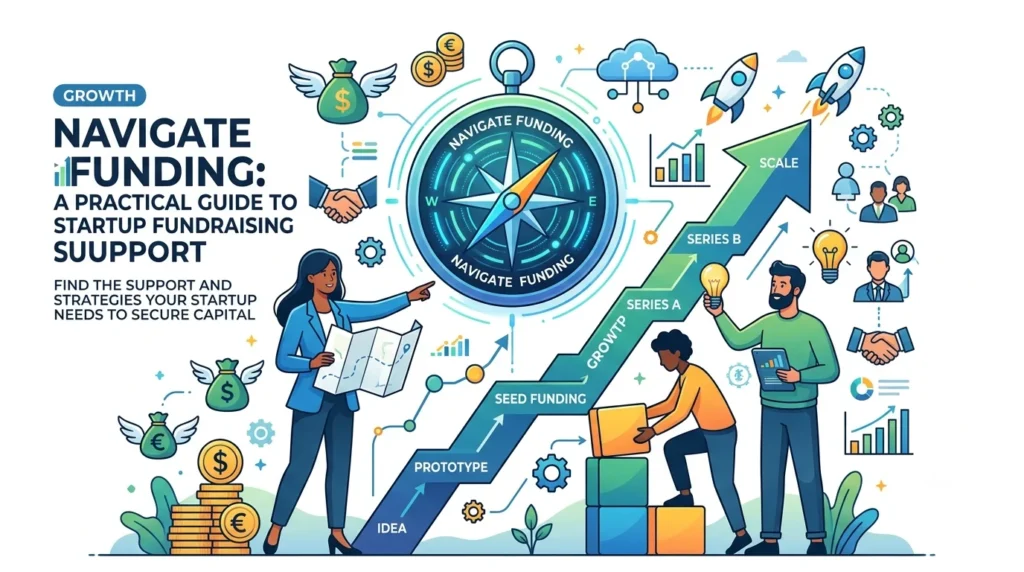
Growth Navigate Funding: A Practical Guide to Startup Fundraising Support.
Introduction
Raising capital is rarely just about finding investors. Founders also need a clear fundraising strategy, credible financial projections, a convincing pitch, appropriate investor targeting, and preparation for due diligence. Growth Navigate Funding positions itself around these parts of the fundraising process, offering advisory support to startups from pre-seed through Series C and beyond.
The term Growth Navigate Funding can also appear in broader discussions about planning and managing business capital. That creates some confusion because the phrase may describe either a funding strategy or the commercial advisory brand using the name. This article focuses primarily on the advisory service represented by the Growth Navigate Funding websites while distinguishing its own published claims from independently verified information.
For founders researching the company, the key questions are practical: What does Growth Navigate Funding offer? How does its process work? What does it cost? Which startups may benefit from this type of advisory support? And what should a business verify before signing a funding-advisory agreement?
This guide covers those questions in detail.
Quick Answer: What Is Growth Navigate Funding?
Growth Navigate Funding presents itself as a startup fundraising advisory service that helps founders prepare for and manage capital raises. Its published services include fundraising strategy, pitch deck development, investor relations and introductions, financial modeling, growth strategy, due diligence preparation, cap-table support, and market expansion advisory.
The company says it works with startups ranging from pre-seed to Series C and beyond. Its website also states that it has worked with more than 300 startups and has helped secure more than $450 million in growth capital. Those figures are company-reported claims, rather than independently audited results.
Key Facts
| Factor | What the company publishes |
|---|---|
| Brand | Growth Navigate Funding |
| Business type | Startup fundraising and growth advisory |
| Stated founding year | 2013 |
| Stated locations | New York and San Francisco |
| Startup stages | Pre-seed through Series C+ |
| Investor network | 1,000+ relationships, according to the company |
| Capital secured | $450M+, according to the company |
| Startups funded | 300+, according to the company |
| Published packages | Launchpad, Navigator and Ascent |
| Lowest listed package | $4,500/month |
| Higher listed package | $9,500/month |
| Custom option | Ascent |
Source: Growth Navigate Funding’s public website and services pages.
What Is Growth Navigate Funding?
Growth Navigate Funding presents itself as a capital advisory partner for startups rather than as a government grant or standard bank-loan provider.
According to its website, the business supports founders throughout the fundraising journey, beginning with strategy and positioning and continuing through investor outreach, term-sheet discussions, closing, and post-funding growth.
The company says its advisory practice was launched in 2013 and that its founders had previous experience in venture-backed companies and investment firms. It also states that the organization works with startups across North America, Europe, and Asia-Pacific.
That distinction matters for anyone searching for “Growth Navigate funding.” A founder looking for a grant or direct financing product should not automatically assume that an advisory service is itself providing capital.
Instead, the primary offering described publicly is fundraising assistance.
In simple terms, the service aims to help a startup become more investor-ready, identify potential investors, manage outreach, prepare financial materials, and navigate the transaction process.
What Services Does Growth Navigate Funding Offer?
The company’s services cover several stages of a startup’s fundraising cycle. Rather than focusing on a single deliverable such as a pitch deck, its published offering spans strategy, investor access, financial preparation, deal support, and post-funding growth.
1. Fundraising Strategy
The first component is fundraising strategy and roadmap development.
Growth Navigate Funding says it creates funding plans based on a startup’s stage, sector, investor landscape, target raise, and business objectives. The published service includes valuation benchmarking, investor targeting, investment-thesis development, competitive positioning, and milestone planning.
A structured roadmap can help founders answer questions such as:
- How much capital should the company seek?
- Which investor types fit the business?
- What milestones should the next round finance?
- Which metrics need improvement before approaching investors?
- How should the company position itself against competitors?
These questions are especially important because fundraising is not simply a numbers exercise. Investors also evaluate market opportunity, team quality, traction, business economics, competitive advantages, and the use of capital.
2. Pitch Deck Development
A pitch deck is often one of the first materials an investor sees.
Growth Navigate Funding says its pitch-deck service covers narrative structure, market sizing, competitive analysis, financial information, team presentation, traction, design, and data visualization. The services page describes a typical full deck architecture of 12–15 slides.
A strong deck should do more than make a startup look professional. It should communicate the business model clearly and give investors enough information to understand why the opportunity deserves further discussion.
For founders, that means the underlying data must be accurate. Design cannot compensate for weak traction, unclear economics, or unsupported projections.
3. Investor Relations and Network Access
Investor introductions form another major part of the company’s published offering.
Growth Navigate Funding states that it maintains relationships with more than 1,000 investors across venture capital, angel, family-office, and strategic-investor categories. The service description also mentions targeted investor lists, warm introductions, CRM management, meeting preparation, follow-up, and relationship nurturing.
Access to investors can potentially reduce the time founders spend identifying relevant prospects.
However, an introduction should not be confused with investment approval. An investor meeting does not guarantee a term sheet, and a warm introduction does not remove the need for due diligence on the startup itself.
4. Financial Modeling
Financial preparation is another significant component.
The company says it develops three-statement financial models covering the profit and loss statement, balance sheet, and cash flow statement. Its offering also includes unit economics, cohort analysis, revenue forecasting, scenario analysis, sensitivity analysis, and cap-table modeling.
For an investor, these materials help explain how the business expects to use capital and what assumptions support the projected growth.
Founders should therefore make sure every major assumption can be explained. Revenue forecasts, customer acquisition costs, margins, hiring plans, cash requirements, and growth expectations should connect logically to the underlying business.
5. Due Diligence Preparation
Fundraising does not end when an investor says they are interested.
Due diligence can involve financial records, corporate documents, legal materials, intellectual property, ownership information, contracts, operational information, and management discussions.
Growth Navigate Funding says its due-diligence service includes virtual data-room organization, document preparation, assumption testing, investor Q&A preparation, and support for IP and technology documentation.
Being prepared before an investor requests these documents can reduce avoidable delays.
6. Growth Strategy Advisory
The company’s services extend beyond the initial capital raise.
Growth Navigate Funding says it provides post-funding support covering go-to-market strategy, revenue optimization, product-market-fit refinement, customer acquisition, OKRs, board reporting, follow-on funding, and potential M&A or exit pathways.
This reflects an important reality of startup finance: raising capital is not the final objective. The business still has to convert that capital into measurable progress.
How Does the Growth Navigate Funding Process Work?
Growth Navigate Funding describes its process in four broad stages.
Step 1: Discovery and Strategy
The process begins with an assessment of the startup’s story, market, funding requirements, and goals.
At this point, the objective is to establish the fundraising roadmap and determine what needs to be prepared before investor outreach.
Step 2: Materials and Positioning
Next comes the development or refinement of the fundraising materials.
That may include the pitch deck, financial model, investor narrative, market information, and supporting documents.
Step 3: Investor Outreach
Once the materials are prepared, the company says it uses its investor network for introductions and manages outreach to prospects aligned with the fundraising requirements.
The quality of investor targeting matters here. A large list of contacts is less useful if those investors have no interest in the startup’s sector, stage, geography, or check size.
Step 4: Closing and Scaling
The final stage involves moving from investor interest toward a completed transaction.
Growth Navigate Funding says it can support term-sheet review, closing, and post-funding growth.
Founders should still involve qualified legal and financial professionals where appropriate, especially when reviewing investment documents or complex ownership arrangements.
Growth Navigate Funding Pricing
Pricing is one of the most important areas for founders evaluating an advisory company.
Growth Navigate Funding’s published services page currently lists three packages: Launchpad, Navigator, and Ascent.
Launchpad — $4,500 per month
The Launchpad package is listed at $4,500 per month.
According to the published package details, it includes:
- A two-hour fundraising strategy session
- Pitch-deck review and feedback
- Investor targeting list with 50 contacts
- Financial-model health check
- Monthly advisory call
- Email and Slack support
This structure appears designed for founders who already have some fundraising materials but want strategic guidance and preparation support.
Navigator — $9,500 per month
The Navigator package is listed at $9,500 per month.
Its published features include:
- Full pitch-deck development
- Three-statement financial model
- Investor list containing 200 targeted contacts
- Up to 10 warm investor introductions per month
- Weekly advisory calls
- Data-room organization
- Cap-table review
The additional services make this a more extensive engagement than Launchpad.
Ascent — Custom Pricing
Ascent uses custom pricing rather than a published monthly rate.
The package includes full-service fundraising support, a dedicated senior advisor, investor introductions, due-diligence management, term-sheet negotiation support, post-close growth advisory, and priority access.
The company also states on its contact page that its primary pricing model is a monthly advisory retainer. It says a small success fee may apply to full-service Ascent engagements.
Because fees can change, founders should confirm the current price, scope, payment terms, refund policy, and any performance-based charges in writing before entering an engagement.
Who Can Use Growth Navigate Funding?
The company says it works with startups from pre-seed through Series C. Its FAQ also states that it works with pre-revenue and early-stage companies, with particular attention to narrative, team credentials, and market opportunity at earlier stages.
Its published sector examples include:
- Fintech
- SaaS
- Healthtech
- Cleantech
- Edtech
- Consumer technology
- Deep tech
That does not mean every startup will receive the same service or investor access.
A company’s stage, geography, sector, traction, capital requirements, and readiness can all affect the usefulness of an advisory engagement.
What Should Founders Prepare Before Seeking Funding?
Advisory support works best when founders already have accurate information about their business.
Before approaching investors, consider preparing the following:
Financial information
Keep revenue figures, expenses, cash balances, liabilities, and forecasts organized. Investors may challenge assumptions, so founders should understand the reasoning behind every major projection.
Cap table
Ownership should be documented clearly. Any existing investors, employee option pools, convertible instruments, or other equity arrangements need to be accounted for.
Business metrics
Depending on the business model, relevant metrics may include revenue growth, recurring revenue, customer acquisition cost, churn, gross margin, retention, average contract value, or customer concentration.
Market information
Founders should understand their addressable market and competitive landscape. Unsupported claims about market size can weaken an otherwise strong pitch.
Use of funds
A funding request becomes easier to evaluate when the company can explain exactly what the capital will finance.
For example, the plan might allocate funds toward product development, hiring, sales expansion, infrastructure, or entering a new market.
Investor Access: What Does It Really Mean?
“Investor access” is one of the most attractive phrases in fundraising services, but founders should look beyond the headline.
Growth Navigate Funding says it has more than 1,000 active investor relationships and provides warm introductions through its network.
Still, the existence of a network does not automatically mean every investor will be appropriate for every startup.
A useful investor-targeting process should consider:
- Investment stage
- Typical check size
- Sector preference
- Geography
- Investment thesis
- Previous portfolio
- Competitive conflicts
- Current investment activity
Founders should therefore ask how investors are selected and what qualifies an introduction as relevant.
Company-Reported Results: How Should They Be Interpreted?
Growth Navigate Funding publicly reports more than $450 million in capital secured, 300+ startups funded, 1,000+ investor relationships, and a 92% funding success rate.
The website also publishes individual success stories involving companies it identifies by sector and funding stage.
These figures are useful as part of initial research, but they should be treated as self-reported company information unless independently verified.
A founder conducting due diligence can ask for additional evidence, such as:
- What does “funding success rate” specifically mean?
- How is the 92% figure calculated?
- Over what period was the metric measured?
- Does “capital secured” include all client capital or only certain engagements?
- How many clients did not complete a raise?
- What percentage of introductions result in investor meetings?
- What industries and stages make up the reported results?
Those questions turn marketing claims into information that can be evaluated more meaningfully.
Is Growth Navigate Funding a Grant or Loan Program?
The publicly available Growth Navigate Funding website describes an advisory service, not a government grant program.
Its published model centers on helping startups raise capital through strategy, investor preparation, investor introductions, financial modeling, and related advisory services.
That distinction is important.
If you encounter a third-party page describing “Growth Navigate Funding” as a guaranteed grant, government scheme, or direct loan, verify the claim against the exact official domain and the terms of the actual offer.
A startup should never assume that a brand name appearing in search results automatically identifies the same organization.
What Should You Verify Before Hiring a Funding Advisor?
Choosing a fundraising advisor involves financial and strategic considerations.
Before signing an agreement, founders should review several areas carefully.
1. Exact scope of work
Ask what the advisor will actually deliver.
A contract should distinguish between strategy, materials, investor introductions, financial modeling, negotiation support, and post-funding services.
2. Fees
Confirm the monthly retainer, setup costs, success fees, expenses, taxes, renewal terms, and cancellation conditions.
3. Investor introductions
Ask how investor targets are selected and whether introductions are guaranteed, expected, or simply part of the service process.
4. Confidentiality
Understand how business plans, financial models, customer information, intellectual property, and other sensitive materials will be handled.
5. Legal responsibilities
Clarify where advisory support ends and regulated legal, accounting, securities, or investment services begin.
6. References
Where appropriate, ask for verifiable references or case studies that are relevant to your company’s stage and industry.
7. Outcome definitions
Terms such as “success rate” can mean different things. Ask for the underlying definition before using the figure to compare providers.
Growth Navigate Funding vs. DIY Fundraising
Founders do not necessarily need an external advisory firm to raise capital.
A startup with strong internal fundraising experience may choose to manage its own pitch materials, investor research, outreach, financial modeling, and negotiations.
An advisory service can become more relevant when a team lacks investor relationships, needs help restructuring its fundraising narrative, or wants additional support preparing for diligence.
The trade-off is straightforward: professional support creates an additional cost, while DIY fundraising requires more founder time and internal expertise.
The right approach depends on the company’s circumstances rather than simply the size of the funding target.
Final Takeaways
Growth Navigate Funding sits at the intersection of startup fundraising, financial preparation, investor outreach, and growth advisory.
Its published services go beyond pitch-deck creation. The company describes a broader process that includes fundraising strategy, financial modeling, investor introductions, due diligence, cap-table support, term-sheet assistance, and post-funding growth planning.
Pricing is publicly listed for two packages, while its higher-tier Ascent service uses custom pricing. The company also publishes substantial performance figures, including $450M+ in capital secured and 300+ startups funded. Those numbers should be understood as company-reported claims and evaluated through appropriate due diligence.
For founders considering the service, the most useful next step is not simply asking whether Growth Navigate Funding can help. Instead, evaluate whether its specific services, investor network, pricing structure, and experience match your startup’s stage and fundraising requirements.
Ultimately, successful fundraising depends on much more than introductions. A credible business model, realistic financial assumptions, clear investor positioning, appropriate documentation, and disciplined capital planning remain central to any startup’s funding strategy.
What is Growth Navigate Funding?
Growth Navigate Funding is the name used by a startup fundraising advisory brand. Its public services include fundraising strategy, pitch decks, investor access, financial modeling, due diligence preparation, growth strategy, and related support.
Does Growth Navigate Funding provide startup funding directly?
Its public website primarily describes advisory and fundraising-support services. The published offering focuses on helping startups prepare for and secure external capital rather than presenting itself as a conventional lender or government grant provider.
How much does Growth Navigate Funding cost?
The published services page lists Launchpad at $4,500 per month and Navigator at $9,500 per month. Ascent uses custom pricing. The company also states that a success fee may apply to some Ascent engagements.
Does Growth Navigate Funding work with early-stage startups?
Yes. The company says it works with startups from pre-seed through Series C and supports pre-revenue and early-stage businesses.
What industries does Growth Navigate Funding cover?
The company lists fintech, SaaS, healthtech, cleantech, edtech, consumer technology, and deep tech among the sectors it has supported.