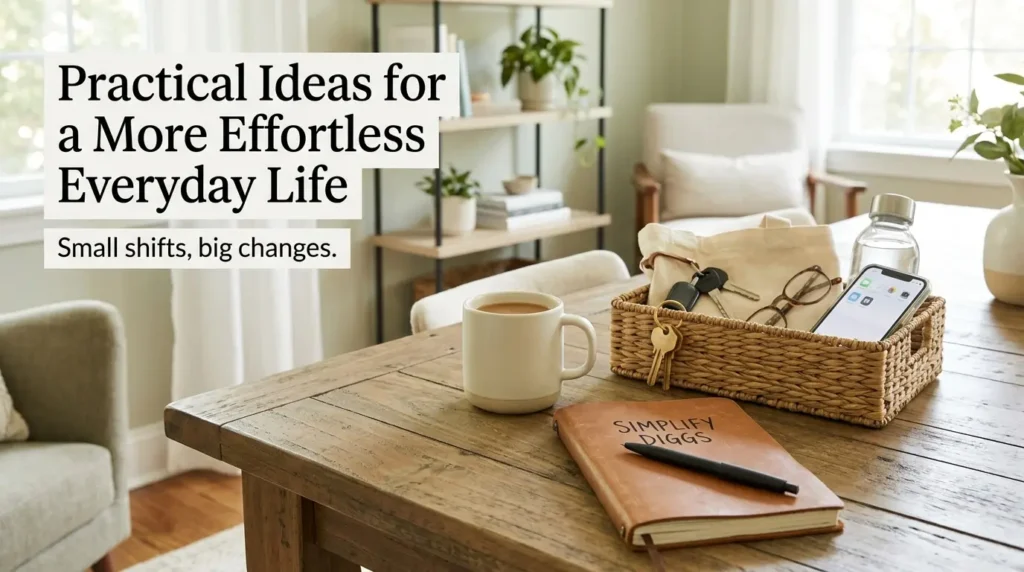
SimplifyDiggs: Practical Ideas for a More Effortless Everyday Life.
Introduction
Life becomes complicated in surprisingly ordinary ways. A crowded workspace can make it harder to concentrate, an overloaded schedule can make priorities unclear, and a messy digital environment can make simple information difficult to find.
The good news is that improving everyday life doesn’t always require a major change.
SimplifyDiggs is built around a straightforward idea: look at the things you regularly do and find practical ways to make them easier.
That could mean creating a better place for frequently used items, simplifying your weekly planning, reducing unnecessary notifications, or changing the way you approach everyday decisions.
The goal isn’t to make life perfectly organized. It’s to create systems that are simple enough to use, flexible enough to change, and useful enough to make a real difference.
What Is SimplifyDiggs?
SimplifyDiggs is a practical approach to simplifying everyday routines, spaces, decisions, and responsibilities.
Instead of asking how to accomplish more, it starts with another question:
“How can this be easier?”
That question can lead to useful changes in many areas:
- Home organization
- Daily routines
- Time management
- Digital organization
- Shopping
- Work habits
- Personal interests
- Weekly planning
The best solutions are usually the ones that fit naturally into your existing lifestyle.
1. Look for Repeated Friction
A good place to start is with something that annoys you repeatedly.
Maybe you’re always:
- Looking for your keys.
- Searching for documents.
- Forgetting small errands.
- Cleaning the same cluttered area.
- Checking several places for information.
- Deciding what to do first.
- Dealing with unnecessary notifications.
These are examples of recurring friction.
Instead of simply accepting the problem, ask whether you can change the process behind it.
2. Simplify Before You Organize
Organization isn’t always the first solution.
If you have too many things, too many commitments, or too many digital files, creating another organizational layer may not solve the underlying problem.
Start by asking:
What can I remove?
You might be able to:
- Delete unnecessary files.
- Cancel unused subscriptions.
- Remove unused applications.
- Reduce commitments.
- Donate items you no longer use.
- Eliminate unnecessary steps.
Once there is less to manage, organization becomes easier.
3. Create Systems for Repeated Tasks
If you repeatedly perform the same task, create a standard way of doing it.
For example:
Grocery shopping
Keep one running list.
Weekly planning
Review the upcoming week at a consistent time.
Important documents
Use one primary storage location.
Daily priorities
Keep one short list.
The system doesn’t have to be complicated.
Its purpose is to make the next repetition easier.
SimplifyDiggs for Your Home
Your environment can influence how easily you complete everyday tasks.
4. Give Important Items a Permanent Home
Frequently used items should have predictable locations.
Examples include:
- Keys
- Wallet
- Work bag
- Chargers
- Important documents
- Frequently used tools
Choose locations based on convenience.
The most important part is returning those items consistently.
5. Organize According to Your Routine
Instead of organizing everything by category alone, consider when you use things.
For example, items you use while getting ready can stay together.
Work materials can remain near your workspace.
Cooking essentials can be stored where they’re easiest to access.
Organization works best when it reflects actual behavior.
6. Start With High-Traffic Areas
Some areas naturally collect more clutter than others.
These might include:
- Entryways
- Desks
- Kitchen counters
- Bedside tables
- Dining areas
Start with one high-use area.
Improving a space you interact with frequently can make the system more noticeable and useful.
7. Use Small Reset Sessions
Don’t wait until your home becomes overwhelming.
Create short reset moments.
For example:
- Return items to their places.
- Clear one surface.
- Put away loose papers.
- Remove obvious rubbish.
- Prepare frequently used items.
Small resets can help prevent larger cleanup sessions.
SimplifyDiggs for Better Time Management
A simpler schedule starts with clear priorities.
8. Choose Your Main Task
At the beginning of the day, ask:
“What is the most important thing I need to move forward today?”
Choose one main priority.
You can still complete smaller responsibilities, but having a clear primary task can prevent the day from becoming scattered.
9. Use Three Levels of Priority
You can organize tasks into three broad groups:
| Priority | Meaning |
|---|---|
| Essential | Needs attention |
| Important | Valuable but may have flexibility |
| Optional | Can wait if necessary |
This doesn’t require complicated productivity software.
A simple list can be enough.
10. Avoid Overloading Your Schedule
A schedule packed from morning to evening leaves little room for unexpected events.
Whenever practical, leave some open space.
That time can absorb:
- Delays
- Additional responsibilities
- Rest
- Personal activities
- Unexpected tasks
Flexibility is part of practical planning.
11. Group Similar Tasks
If you have several small tasks of the same type, consider handling them together.
For example:
Messages: respond during designated periods.
Errands: combine them when practical.
Administration: handle documents and forms together.
Planning: review upcoming commitments at one time.
Grouping tasks can make recurring responsibilities easier to manage.
SimplifyDiggs for Digital Organization
Digital clutter can be just as distracting as physical clutter.
12. Review Your Notifications
Not every application needs to interrupt you.
Check your notification settings.
Keep alerts that are genuinely useful.
Reduce unnecessary interruptions where appropriate.
A quieter device can make it easier to focus on what you’re actually doing.
13. Keep Digital Folders Simple
You don’t need dozens of folders.
Create categories that are easy to understand.
For example:
Work
- Current
- Completed
- Reference
Personal
- Documents
- Travel
- Finance
Use whatever categories make sense for your needs.
14. Clean Temporary Files
Temporary digital spaces can accumulate quickly.
Periodically review:
- Downloads
- Screenshots
- Duplicate files
- Old installers
- Unused applications
- Outdated bookmarks
Deal with one category at a time.
15. Create a Single Source of Truth
When important information is scattered across several apps, notebooks, messages, and documents, finding it can become difficult.
For certain types of information, choose one primary location.
For example:
- One main calendar for appointments
- One main task list
- One primary location for important documents
This doesn’t mean everything has to exist in one application.
It means you know where to look first.
SimplifyDiggs and Smarter Shopping
Shopping decisions can also add unnecessary complexity.
16. Shop With a Purpose
Before purchasing something, ask:
What problem is this solving?
If the answer is unclear, consider waiting.
This is especially useful for nonessential purchases.
17. Check What You Already Own
Before buying something similar to an item you already have, check your existing belongings.
You may discover that:
- You already own the item.
- Another item performs the same function.
- You rarely use the category.
- You can repair or reuse something.
This can reduce unnecessary accumulation.
18. Think About the Space an Item Requires
Every physical purchase needs somewhere to go.
Before buying, consider:
- Where will I store it?
- How often will I use it?
- Does it need maintenance?
- Will it replace something else?
The purchase itself is only one part of the decision.
SimplifyDiggs and Work
Simple systems can also improve your work environment.
19. Prepare Your Workspace for the Next Session
At the end of your work period, take a few moments to:
- Save important work.
- Close unnecessary windows.
- Organize current documents.
- Write down unfinished tasks.
- Clear obvious clutter.
The next session can then begin with less preparation.
20. Define the Next Action
Large tasks can feel vague.
Instead of:
“Work on project.”
Write:
“Review the first section.”
Instead of:
“Organize files.”
Write:
“Create a folder for current documents.”
A clearly defined next action makes it easier to begin.
21. Separate Active and Completed Work
If you work with many files, separate current work from finished material.
For example:
Current
Work that needs attention.
Completed
Finished projects.
Reference
Information you may need later.
This simple structure can make active work easier to identify.
SimplifyDiggs and Personal Time
Simplification isn’t only about productivity.
It’s also about creating room for things you enjoy.
22. Decide What Deserves More Space in Your Life
Ask yourself:
“What would I like to have more time for?”
Your answer could be:
- Family
- Friends
- Reading
- Exercise
- Travel
- Music
- Sports
- Creative activities
- Learning
- Relaxation
Once you know what matters, you can evaluate other commitments more carefully.
23. Make Enjoyable Activities Convenient
If an activity requires too much preparation, it can be easy to postpone.
Make it easier.
Keep books visible.
Store hobby equipment together.
Prepare your workspace.
Keep necessary materials ready.
The objective is to reduce the barrier to starting.
24. Don’t Turn Every Hobby Into a Goal
Some activities are valuable simply because you enjoy them.
You don’t have to measure every hobby.
You don’t have to monetize it.
You don’t have to become highly skilled.
Enjoying something is enough.
SimplifyDiggs Decision Framework
When facing an everyday decision, use these five questions:
1. Is this necessary?
If not, consider whether it deserves your time or money.
2. Does it add meaningful value?
Think beyond convenience.
3. Can the process be simpler?
Look for unnecessary steps.
4. Will this create future work?
Consider maintenance and responsibility.
5. Can I create a rule for next time?
Repeated decisions may benefit from a simple default.
A Simple Weekly SimplifyDiggs Review
Set aside a short period each week to review your systems.
| Area | Question |
|---|---|
| Home | What area needs attention? |
| Work | What is currently most important? |
| Digital | What can be deleted or organized? |
| Schedule | What is coming up? |
| Shopping | What do I actually need? |
| Personal | What activity deserves more time? |
| Systems | What keeps causing unnecessary work? |
Don’t try to fix everything.
Choose one improvement.
7 SimplifyDiggs Habits Worth Trying
If you want a simple starting point, try these:
- Give frequently used items permanent homes.
- Keep one primary calendar.
- Maintain a running shopping list.
- Review your priorities each day.
- Reduce unnecessary notifications.
- Reset your workspace after use.
- Review one recurring problem each week.
None of these requires a complicated system.
Mistakes That Can Make Simplification Harder
Trying to change everything at once
Large changes can be difficult to maintain.
Creating complicated systems
A system should reduce work, not create more.
Buying more instead of removing
Sometimes the best solution is subtraction.
Organizing for appearance only
A beautiful system isn’t useful if you don’t use it.
Ignoring personal preferences
Your systems should fit your habits.
Expecting perfection
Life changes, and your systems should change with it.
A 15-Minute SimplifyDiggs Challenge
Want to start right now?
Minutes 1–3
Identify one recurring frustration.
Minutes 4–6
Write down why it keeps happening.
Minutes 7–9
Remove one unnecessary step.
Minutes 10–12
Create a simple replacement system.
Minutes 13–15
Use the new system immediately.
Then observe whether it actually makes things easier.
If it doesn’t, modify it.
Frequently Asked Questions About SimplifyDiggs
What is SimplifyDiggs?
SimplifyDiggs is a practical approach to making everyday life easier through organization, simple systems, better routines, and thoughtful decisions. It focuses on reducing unnecessary complexity without removing the things that matter.
How can SimplifyDiggs help with everyday organization?
SimplifyDiggs encourages you to create predictable systems for recurring tasks and frequently used belongings. This can make it easier to find things, remember responsibilities, and maintain your environment.
Does simplifying life mean getting rid of everything?
No, simplifying life does not mean removing everything you own or enjoy. The goal is to reduce unnecessary clutter and complexity while keeping useful and meaningful things.
How can I simplify my digital life?
Start by reducing unnecessary notifications, organizing important files, and removing digital items you no longer need. Keeping a simple structure for active and reference information can also make digital tasks easier.
How can I make my schedule less complicated?
Start by identifying your most important responsibilities and keeping your priority list manageable. Leave some flexibility in your schedule so unexpected tasks don’t disrupt everything else.
What is the easiest SimplifyDiggs habit to start?
Give one frequently misplaced item a permanent home and always return it there after use. This small system can eliminate a recurring problem without requiring major lifestyle changes.
Conclusion
SimplifyDiggs is about reducing unnecessary friction in everyday life.
You don’t need to reorganize your entire home, completely redesign your schedule, or adopt an elaborate productivity method.
Instead:
- Identify one recurring problem.
- Understand why it happens.
- Remove what isn’t necessary.
- Create a simple system.
- Repeat what works.
Over time, small improvements can make everyday responsibilities easier to handle.
The goal isn’t to make life perfectly efficient.
The goal is to make ordinary life simpler, clearer, and easier to manage—while leaving more room for the people, activities, and experiences that matter most.