
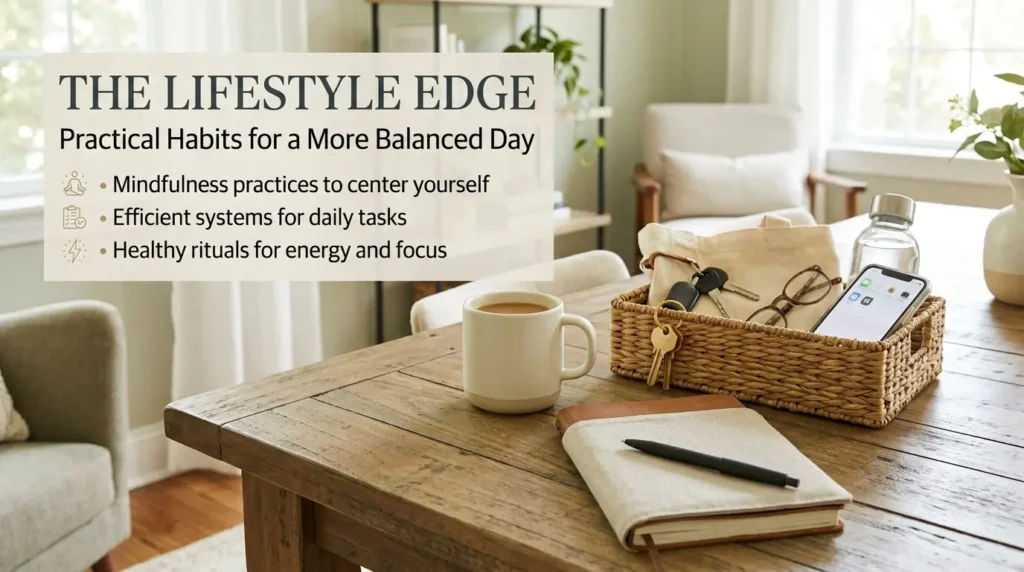
The Lifestyle Edge: Practical Habits for a More Balanced Day.
Introduction
A better lifestyle isn’t necessarily about making dramatic changes. Often, it comes from improving the small decisions and routines that shape an ordinary day.
How you start your morning, where you keep important belongings, how you manage your schedule, what you allow to interrupt your attention, and whether you make time for activities you enjoy can all influence how manageable your day feels.
The Lifestyle Edge is about finding practical ways to make those everyday choices work better.
This doesn’t mean following a strict routine or trying to optimize every minute. Instead, it means creating simple habits that reduce unnecessary effort, improve organization, and make room for the things that genuinely matter.
What Is The Lifestyle Edge?
The Lifestyle Edge is a practical approach to improving everyday life through intentional habits, better organization, thoughtful decisions, and flexible routines.
It can be applied to almost any part of daily living.
For example:
- Creating a simpler morning routine
- Organizing your home around actual use
- Planning important tasks ahead of time
- Reducing digital distractions
- Making more deliberate purchases
- Protecting personal time
- Reviewing routines when circumstances change
The key idea is simple:
Make useful things easier to repeat and unnecessary things easier to remove.
1. Identify What Makes Your Day Harder
Before changing your routine, notice where problems repeatedly occur.
Ask yourself:
- What do I keep forgetting?
- What takes longer than it should?
- What regularly creates clutter?
- Which tasks do I keep postponing?
- What repeatedly interrupts my attention?
- Which decisions do I make over and over?
These questions can reveal opportunities for improvement.
You don’t need to fix everything.
Choose one recurring issue.
2. Start With Small Improvements
A small improvement that you actually maintain can be more useful than a large plan you abandon.
For example, instead of reorganizing your entire home, organize one drawer.
Instead of redesigning your whole schedule, identify tomorrow’s main priority.
Instead of cleaning every digital file, start with your downloads folder.
Small changes are easier to test.
3. Make Your Environment Support Your Habits
Your surroundings can make certain actions easier or harder.
If you want to read more, keep your current book accessible.
If you want to organize your workspace, keep essential materials together.
If you frequently lose your keys, create a designated place for them.
The principle is simple:
Make useful behavior convenient.
The Lifestyle Edge and Morning Routines
A morning routine doesn’t need to contain dozens of activities.
4. Create a Basic Morning Sequence
A practical morning structure might include:
- Get ready.
- Check your schedule.
- Identify your main priority.
- Start the day.
You can add other activities if they genuinely improve your mornings.
Avoid adding habits simply because they are popular.
5. Prepare Before You Go to Bed
Think about what commonly causes morning delays.
If you’re often looking for something, prepare it the night before.
This could include:
- Work materials
- Clothing
- A bag
- Important documents
- Your first task
You don’t need a long preparation routine.
One useful step may be enough.
6. Avoid Starting With Too Many Decisions
Mornings can become unnecessarily complicated when every action requires a decision.
Create simple defaults where appropriate.
For example:
- A small selection of regular breakfasts
- A consistent place for essentials
- A standard morning checklist
- A regular first task
Defaults can reduce unnecessary decision-making.
The Lifestyle Edge and Home Organization
A well-organized home should make daily activities easier.
7. Give Frequently Used Items a Home
Choose consistent locations for items you use regularly.
Examples:
- Keys
- Wallet
- Bag
- Chargers
- Documents
- Work equipment
The exact location doesn’t matter.
Consistency does.
8. Organize Based on Frequency
Think about how often you use something.
Daily items
Keep them easy to access.
Weekly items
Store them conveniently.
Occasional items
Keep them away from high-use areas.
Rarely used items
Consider whether they still need to take up valuable space.
This makes organization functional rather than purely visual.
9. Focus on One Problem Area
Instead of trying to organize an entire room, identify the area that causes the most inconvenience.
It might be:
- A desk
- An entryway
- A kitchen counter
- A wardrobe
- A drawer
Fix that area first.
10. Create a Daily Reset
At the end of the day, return commonly used items to their places.
You can also:
- Clear your workspace
- Put away loose items
- Review tomorrow’s schedule
- Remove obvious clutter
The goal is to leave your environment ready for the next day.
The Lifestyle Edge and Time Management
Time management doesn’t mean filling every minute.
It means understanding what deserves your attention.
11. Choose One Main Priority
Start by identifying the task that matters most.
Ask:
“If I complete only one important thing today, what should it be?”
That task becomes your primary focus.
Other responsibilities can follow.
12. Use a Simple Priority System
You can divide tasks into:
| Level | Meaning |
|---|---|
| Essential | Needs attention |
| Important | Valuable but flexible |
| Optional | Can wait |
This simple distinction can make a long task list easier to understand.
13. Stop Treating Every Task as Urgent
A new message, notification, or request doesn’t automatically deserve immediate attention.
Before switching tasks, consider:
- Is there a real deadline?
- Does someone depend on this now?
- What happens if I handle it later?
- Is it more important than my current task?
These questions can help protect your priorities.
14. Leave Some Space in Your Schedule
An overly full schedule can become difficult to maintain.
Whenever possible, leave some flexible time.
Unexpected tasks happen.
Plans change.
Things take longer than expected.
A little space makes your schedule more adaptable.
The Lifestyle Edge and Digital Life
Digital clutter can create unnecessary mental and practical work.
15. Reduce Unnecessary Notifications
Review the notifications you receive.
Ask:
“Does this need my immediate attention?”
Keep important alerts.
Reduce the rest where appropriate.
16. Organize Important Files
Create a straightforward structure for digital documents.
For example:
Work
- Current
- Completed
- Reference
Personal
- Documents
- Travel
- Finance
Use categories that make sense for your own needs.
17. Clean One Digital Category at a Time
Instead of attempting to clean every digital account, choose one category.
You could review:
- Downloads
- Screenshots
- Bookmarks
- Unused applications
- Email subscriptions
- Duplicate files
Small cleanups are easier to complete.
18. Create Device-Free Moments
Choose certain activities where you intentionally put your phone aside.
Examples include:
- Meals
- Conversations
- Reading
- Hobbies
- Focused work
This creates a clearer boundary around your attention.
The Lifestyle Edge and Smarter Spending
Your lifestyle is influenced not only by what you do, but also by what you bring into your environment.
19. Ask What a Purchase Will Solve
Before buying something, ask:
What problem does this solve?
Then consider:
- Do I already own something similar?
- How often will I use it?
- Where will I keep it?
- Does it require maintenance?
- Is it genuinely useful?
These questions can make everyday purchasing more intentional.
20. Avoid Buying for an Imaginary Routine
Sometimes people buy products for a lifestyle they hope to have.
Instead, consider your actual habits.
If you rarely use something, purchasing specialized equipment for it may create more clutter than value.
Buy according to realistic use.
21. Keep a Running Shopping List
Use one list for household items you genuinely need.
Add items when you notice they’re running low.
Review the list before shopping.
This can make shopping more deliberate and reduce reliance on memory.
The Lifestyle Edge and Personal Time
A balanced lifestyle includes responsibilities and activities you genuinely enjoy.
22. Identify What You Want More Time For
Ask:
“If I had more free time, how would I want to spend it?”
Possible answers might include:
- Reading
- Exercise
- Sports
- Music
- Cooking
- Friends
- Family
- Travel
- Creative hobbies
Your answer can help you decide what deserves more space in your schedule.
23. Make Hobbies Easy to Begin
Reduce preparation.
Keep your book visible.
Store your sports equipment together.
Keep creative supplies accessible.
Set up your hobby space so you can start without a lengthy preparation process.
24. Don’t Turn Everything Into Productivity
Not every activity needs to produce a measurable result.
You can read because you enjoy reading.
You can walk because it feels good.
You can listen to music because you like it.
A fulfilling lifestyle includes activities that are valuable simply because you enjoy them.
The Lifestyle Edge and Personal Growth
Improvement should be connected to what matters to you.
25. Choose Practical Skills
Consider learning something that can improve your everyday life.
Examples include:
- Cooking
- Writing
- Communication
- Technology
- Organization
- Financial planning
- Creative skills
Focus on skills that are relevant to your goals and interests.
26. Keep Track of What Works
Create a simple note called:
“Things That Make My Life Easier.”
Add observations such as:
- Preparing at night makes mornings smoother.
- Keeping documents together saves time.
- A weekly review helps with planning.
- A clear workspace makes starting work easier.
This becomes a personal reference guide.
27. Review Your Lifestyle Regularly
Your routine doesn’t need to stay unchanged forever.
Every few weeks, ask:
- What’s working?
- What’s no longer useful?
- What keeps creating friction?
- What deserves more attention?
- What could be removed?
Then make one adjustment.
A Simple Lifestyle Edge Weekly Review
Use this table as a quick weekly check-in:
| Area | Question |
|---|---|
| Home | What needs organizing? |
| Schedule | What deserves priority? |
| Digital | What can be cleaned up? |
| Shopping | What do I actually need? |
| Personal time | What do I want to enjoy? |
| Relationships | Who should I connect with? |
| Next week | What one change would help? |
Keep it practical.
The review should make your week easier, not become another obligation.
A Five-Step Lifestyle Edge Method
When you encounter a recurring problem, follow these steps.
Step 1: Notice
Identify the problem.
Step 2: Understand
Figure out why it keeps happening.
Step 3: Remove
Eliminate unnecessary steps.
Step 4: Simplify
Create a practical alternative.
Step 5: Maintain
Make the new approach easy to repeat.
This method can work for household tasks, schedules, digital organization, shopping, and many other everyday situations.
Common Mistakes to Avoid
Trying to change everything
Focus on one improvement at a time.
Creating overly detailed routines
If a routine requires constant management, simplify it.
Organizing without removing
Sometimes fewer items are more useful than better storage.
Copying someone else’s lifestyle
What works for one person may not fit another.
Filling every free moment
Leave room for rest and unexpected events.
Ignoring enjoyment
A better lifestyle should include things you genuinely like.
A 15-Minute Lifestyle Edge Reset
Try this simple exercise today.
Minutes 1–3
Choose one recurring frustration.
Minutes 4–6
Identify its cause.
Minutes 7–9
Remove one unnecessary step.
Minutes 10–12
Create a simpler process.
Minutes 13–15
Put the new approach into practice.
Don’t worry about making it perfect.
See whether it actually helps.
Frequently Asked Questions About The Lifestyle Edge
What is The Lifestyle Edge?
The Lifestyle Edge is a practical approach to creating a more organized, manageable, and enjoyable everyday life. It focuses on simple habits, thoughtful decisions, better routines, and reducing unnecessary complexity.
How can I improve my lifestyle without making major changes?
Start by changing one recurring part of your daily routine. Small improvements such as organizing frequently used items, preparing ahead, or reducing unnecessary digital distractions can be easier to maintain.
Does The Lifestyle Edge require minimalism?
No, The Lifestyle Edge does not require a minimalist lifestyle. The focus is on keeping what is useful and meaningful while reducing unnecessary clutter and complexity.
How can I manage my time more effectively?
Identify your most important responsibility and organize your day around it. Keep your priorities manageable and leave some flexibility for unexpected tasks.
How can I make more time for things I enjoy?
Identify activities that genuinely matter to you and deliberately create space for them. Making hobbies easier to start can also increase the likelihood that you’ll actually spend time on them.
What is one simple habit I can start today?
Choose one thing you can prepare today that will make tomorrow easier. This could be your workspace, schedule, bag, clothing, or first priority.
Conclusion
The Lifestyle Edge is built through practical improvements, not dramatic transformations.
You don’t need a perfect routine.
You don’t need to optimize every minute.
You simply need to notice where everyday life creates unnecessary friction and make thoughtful adjustments.
Organize what you use.
Remove what you don’t need.
Protect what matters.
Create routines that support your actual life.
And give yourself enough flexibility to change them when necessary.
The result isn’t a perfectly optimized lifestyle.
It’s something more useful: a daily life that feels easier to manage and leaves more room for the people, activities, and experiences you value.

Pingback: BrumeBlog: Digital Content, Blogging, Topics & What to Know.