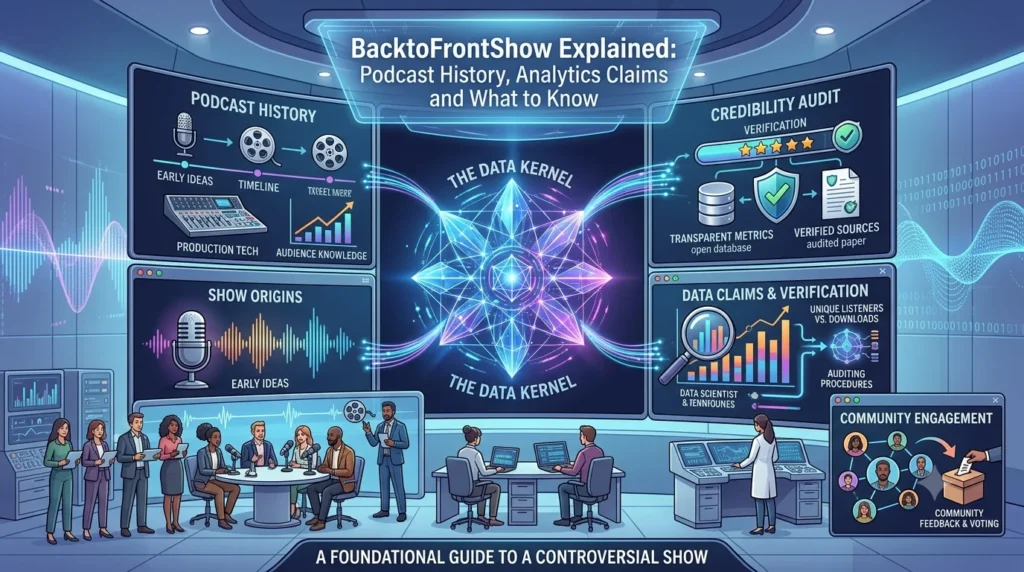
BacktoFrontShow Explained: Podcast History, Analytics Claims and What to Know.
Introduction
Searching for BacktoFrontShow can lead to different descriptions of the same name. Some pages connect it with an older podcast about web design and development. Others describe a podcast analytics service that claims to help creators understand their audiences, track engagement and prepare reports.
That difference matters. When a website name appears in several contexts, readers need to establish which version they have found before relying on its information or spending money on a service.
The current website at BacktoFrontShow.com presents itself as a podcast analytics platform. Its homepage advertises audience demographics, listening behaviour, device analytics, geographical insights and customised reports. However, those website claims should not automatically be treated as independently verified product capabilities.
This guide explains what BacktoFrontShow refers to, explores the older podcast associated with the name, examines the current website’s advertised features and outlines practical checks for anyone considering the service.
Quick Answer: What Is BacktoFrontShow?
| Question | Answer |
|---|---|
| What is BacktoFrontShow? | The name appears in connection with an older web-industry podcast and a website currently advertising podcast analytics. |
| What was The Back to Front Show? | A podcast hosted by Keir Whitaker and Kieran Masterton, covering web development, design, startups and related topics. |
| What does the current website advertise? | Audience demographics, listening behaviour, engagement metrics, device insights and custom reporting. |
| Is the analytics service independently verified? | The website describes its features, but readers should verify its capabilities and business details before relying on them. |
| Does the website display prices? | Yes. Its homepage displays Basic and Pro prices, as well as an Enterprise option requiring a pricing enquiry. These are advertised prices, not independent proof of service delivery. |
| What should potential users do? | Request a demonstration, confirm data sources, review terms and privacy practices, and test whether the service delivers useful insights. |
1. What Is BacktoFrontShow?
BacktoFrontShow is a name that requires context because online references do not all describe the same thing.
The current official website presents BacktoFrontShow as a podcast analytics platform for podcasters and media teams. According to its homepage, the service aims to provide more information about listeners than basic download figures alone.
Its advertised features cover several areas:
- Audience demographics and interests
- Listening behaviour
- Episode engagement
- Device analytics
- Geographical reporting
- Custom dashboards and reports
These capabilities, if available and supported by reliable data, could help podcast creators understand how audiences interact with their content.
However, a website’s feature descriptions do not establish how accurately a product measures each metric, which podcast platforms it supports or how it collects the underlying information. Prospective customers should confirm those details directly.
Why Do People Search for BacktoFrontShow?
A person searching for BacktoFrontShow may have encountered the name in a search result, an article, a podcast directory or a website promoting analytics services.
Their questions may include:
- What does BacktoFrontShow do?
- Is it a podcast or a software platform?
- Who created the original show?
- Does the analytics service offer useful features?
- How much does it cost?
- Can its claims be independently verified?
A useful explanation needs to answer these questions without confusing historical information with current commercial claims.
2. The Original Back to Front Show Podcast
The Back to Front Show was a web-industry podcast hosted by Keir Whitaker and Kieran Masterton. Archived episode pages describe it as a show about web technology, development and the wider professional world surrounding the web.
The archive includes conversations about web design, development tools, startups, freelancing, creative work and changes in the technology industry.
For example, the archived first episode describes discussions about co-working, website generation tools, web design events and equipment for recording the podcast. Another archived episode, Episode 38, explores the benefits and challenges of remote working.
These records provide a more specific picture of the original programme than a general description of a digital show.
Who Hosted the Podcast?
The archived episode pages identify Keir Whitaker and Kieran Masterton as the hosts. Their conversations focused on professional experiences and developments across the web industry.
Rather than functioning as a conventional software product, the original show offered listeners discussions about the work, tools and people connected with web design and development.
Is the Original Podcast Still Active?
The podcast directory The Podcast App lists an episode titled Retro Tech Rabbit Warren, dated 17 December 2020, as the latest episode in its catalogue.
That listing suggests the original podcast’s published run ended in 2020. Readers looking for the historic programme should distinguish its archived episodes from newer pages that use the BacktoFrontShow name for a different purpose.
3. Why Are There Different Descriptions of BacktoFrontShow?
The search results for BacktoFrontShow can be confusing because they include historical podcast pages alongside newer material describing an analytics platform.
The current homepage promotes podcast audience insights and reporting. Meanwhile, archived episode pages retain their original descriptions of a web-focused podcast.
Both types of pages may appear under the same domain, but they serve different purposes.
Historical Content Versus Current Product Claims
Historical content can establish what an earlier podcast covered and who hosted it. A current product page, by contrast, can show how a website presently describes its service.
Neither type of page automatically verifies the other.
For instance, an archived episode does not prove that an analytics platform works. Similarly, a modern feature list does not establish that the current service has the same ownership, team or operating history as the original podcast.
How to Evaluate Conflicting Information
When different websites provide inconsistent descriptions, follow a simple verification process:
- Start with the official website. Identify the exact product or programme it currently describes.
- Check dated records. Podcast directories and archived episode pages can help establish historical details.
- Look for independent coverage. Search for credible reviews that explain the reviewer’s experience and methodology.
- Verify commercial details. Confirm the provider’s identity, contract terms, pricing and support arrangements.
- Avoid repeating unsupported claims. If a detail lacks reliable evidence, describe it as unconfirmed instead of presenting it as fact.
This approach helps readers separate information that a source documents from claims that still require evidence.
4. What Features Does the Current Website Advertise?
The current BacktoFrontShow homepage lists several analytics features. The following sections explain what those features could mean for podcast creators while distinguishing general industry uses from claims about the specific service.
Audience Demographics
Audience demographic reporting can help a creator understand characteristics of the people who listen to a show.
Depending on the data source and its permissions, analytics may include broad geographical information or other audience attributes. However, not every podcast platform provides the same demographic data, and some information may rely on estimates or limited samples.
Before relying on this feature, ask BacktoFrontShow which attributes it actually reports, where the data comes from and how it handles incomplete information.
Listening Behaviour
Listening behaviour analytics can help creators investigate how audiences interact with episodes.
Useful measurements may include listening duration, completion rates, returning listeners or changes in consumption over time. Availability depends on the platform, the measurement method and the data that a provider can access.
The key question is whether BacktoFrontShow supplies these measurements with clear definitions. A dashboard becomes more useful when users understand what each metric measures and what it leaves out.
Engagement Metrics
The website advertises engagement insights involving likes, shares and comments.
These signals can help creators identify topics that prompt audience responses. Nevertheless, engagement varies across platforms, and a provider may not have access to every interaction.
Before using these figures to compare episodes, confirm that the service collects equivalent data across the platforms included in a report.
Device Analytics
Device analytics can show which device types or listening environments audiences use, where the data source supports that information.
Such insights may help a creator identify technical issues or decide how to promote content. For example, a team might check whether its episode pages work well on mobile devices.
However, device information alone cannot explain why someone chooses one device over another. Creators should combine it with other evidence before changing their content strategy.
Geographical Insights
The website also advertises geographical reporting.
Location information can help a podcast team identify regions where its audience appears concentrated. A creator might use that information to explore local partnerships, relevant topics or possible event locations.
Accuracy depends on the data source and its ability to estimate location. Privacy restrictions, network routing and platform reporting practices can limit precision, so users should not assume that every location figure represents an exact listener location.
Custom Reports
Custom reporting can bring several metrics together in a format that suits a creator, agency or media team.
For example, a report might compare episode performance over a selected period, summarise available engagement data and show changes across supported platforms.
The value depends on more than appearance. Reports should use consistent definitions, identify their data sources and help users answer specific business questions.
Important: These descriptions explain common uses of podcast analytics and the features the website advertises. They do not independently confirm the current service’s data accuracy, integrations or actual performance.
5. How Podcast Analytics Can Help Creators
Podcast analytics can support better decisions when creators connect the numbers with clear goals.
Identify Topics That Resonate
A creator can compare episodes to investigate which subjects attract attention or encourage repeat listening.
Suppose a business podcast publishes episodes about marketing, entrepreneurship and customer service. The team could compare available listening and engagement metrics to see which topics deserve further exploration.
One popular episode does not prove that every similar episode will succeed. Instead, look for patterns across multiple releases and consider episode length, guest quality, promotion and timing.
Improve Publishing Decisions
Analytics may reveal differences in performance by publishing date, episode format or distribution channel.
Creators can use those observations to test changes to their schedule or promotion strategy. However, correlation does not always establish cause and effect. A rise in listening figures might reflect a guest’s audience or a marketing campaign rather than the publishing time alone.
Prepare Sponsorship Reports
Podcast teams often need to explain audience reach and engagement to potential sponsors.
Clear reports can help a team communicate the measurements it actually has. Nevertheless, sponsorship proposals should distinguish downloads, plays, unique listeners and engagement rather than presenting them as interchangeable figures.
Before sharing a report, verify the reporting period, metric definitions and source data. Avoid making audience claims that the evidence cannot support.
Measure Progress Against Specific Goals
More data does not automatically lead to better results. Creators should first decide what they want to improve.
Possible goals include increasing returning listeners, attracting a relevant audience, improving episode completion or generating qualified website visits. Once a team chooses a goal, it can select metrics that provide meaningful evidence of progress.
This process prevents teams from spending time on attractive dashboards that do not influence practical decisions.
6. What to Check Before Using BacktoFrontShow
If you are considering BacktoFrontShow as an analytics service, review the details below before connecting a podcast or purchasing a plan.
Confirm the Data Sources
Ask which podcast hosting services and distribution platforms the product supports.
Find out whether it uses direct integrations, imported reports, tracking links or another collection method. Also, clarify which metrics come directly from source platforms and which the provider calculates or estimates.
A credible demonstration should explain how the product obtains its data, not just show charts.
Request a Live Demonstration
A demonstration can help you assess whether the service meets your needs.
Ask the provider to show a real workflow, explain its main metrics and demonstrate how users export or share reports. If possible, use a small test dataset to compare its output with figures from your existing analytics sources.
Do not assume that a polished dashboard guarantees accurate or complete data.
Review Privacy and Data Handling
Podcast analytics may involve audience information, account connections or other potentially sensitive business data.
Before granting access, review the privacy policy and terms of service. Check what information the service collects, how it stores that information, whether it shares data with third parties and how users can request deletion.
Also, confirm the permissions required to connect your podcast accounts. Avoid providing passwords or access rights that the service does not reasonably need.
Verify Pricing and Contract Terms
The website currently displays prices for Basic and Pro plans, plus an Enterprise option that requires a pricing enquiry. Those figures describe what the website advertises; they do not independently establish the service’s value or suitability.
Before paying, ask about billing frequency, taxes, cancellation terms, minimum commitments, data limits and any additional charges. Make sure the written agreement matches the offer presented during a sales conversation.
Look for Independent Evidence
Testimonials on a provider’s own website are not the same as independent reviews.
Look for reviews that identify the reviewer, explain the testing process and describe both benefits and limitations. Where independent evidence is limited, treat that as an uncertainty rather than assuming either that the product works well or that it is fraudulent.
Assess Customer Support
Ask how the provider handles technical questions, account problems and data discrepancies.
Clarify its support hours, response expectations and available contact channels. For a business that relies on reporting, support matters when a dashboard stops updating or a critical metric appears incorrect.
7. BacktoFrontShow Pricing: What Is Publicly Displayed?
The current BacktoFrontShow homepage displays three plan options.
| Plan | Price displayed on the website | What the website lists |
|---|---|---|
| Basic | $1,200 per month | Listener demographics, episode performance, listening trends, custom reporting and feedback analysis |
| Pro | $3,600 per month | Basic features plus listed audience growth, segmentation and engagement capabilities |
| Enterprise | Contact for pricing | Listed advanced analytics and integrations with marketing or CRM tools |
These are the prices shown on the website when reviewed for this article. Confirm the current offer directly with the provider before making a purchasing decision.
Is the Pricing Worth It?
The answer depends on the service’s actual capabilities and the value it provides to your organisation.
A large podcast network may need consolidated reporting across multiple shows, detailed audience analysis or integrations with other business systems. A new independent creator may have simpler needs that existing hosting or distribution dashboards already meet.
Compare the advertised cost with your current tools, the amount of time the product saves, the quality of its data and the decisions it helps you make.
Most importantly, do not judge value from a feature list alone. Request evidence that the platform can deliver the specific metrics and workflows your team needs.
8. Alternatives and Other Ways to Measure Podcast Performance
You do not necessarily need a separate analytics platform to begin understanding podcast performance.
Start by reviewing the analytics available through your podcast host and distribution platforms. Depending on where you publish, those tools may already offer useful information about episode performance, audience behaviour and listening trends.
Use Your Existing Platform Reports
Your hosting service may provide download statistics and other episode-level measurements. Individual listening platforms may offer their own audience or engagement reports.
The available metrics can differ, so read each platform’s definitions before comparing figures.
Build a Simple Reporting Spreadsheet
A spreadsheet can help a small team track a consistent set of measurements over time.
For example, you could record:
- Episode title and publication date
- Downloads or plays, clearly labelled by source
- Available listening or completion metrics
- Website visits attributed to the episode
- Newsletter sign-ups or other relevant conversions
- Promotion activities associated with the release
This approach will not replace every analytics integration, but it can help a creator establish a baseline before investing in another tool.
Consider a Dedicated Tool When Needed
A dedicated analytics product may be worth evaluating when your team manages several shows, needs recurring reports or must combine data from multiple sources.
Compare providers using the same checklist: supported platforms, metric definitions, privacy practices, export options, support and total cost.
If BacktoFrontShow meets those requirements and demonstrates reliable results, you can evaluate it against alternatives. Until then, treat its advertised features as claims to investigate rather than a reason to commit immediately.
9. Final Thoughts
BacktoFrontShow is a useful example of why readers should examine context when researching a name online. Historical pages describe The Back to Front Show, a web-industry podcast hosted by Keir Whitaker and Kieran Masterton. The current website, meanwhile, presents podcast analytics features aimed at creators and media teams.
Podcast analytics can help creators understand audience behaviour, evaluate episodes and prepare reports. However, the usefulness of any platform depends on its data sources, accuracy, privacy practices and ability to support real decisions.
If you are considering BacktoFrontShow as a service, verify its advertised features, request a demonstration and review its commercial terms before committing. Compare the results with existing analytics tools, and do not mistake website claims or testimonials for independent proof.
A careful approach will help you separate historical information from current product claims and make a more informed decision about whether the service fits your needs.
What is BacktoFrontShow?
BacktoFrontShow is a name associated with an older web-industry podcast and a website that currently advertises podcast analytics. Readers should check the context of each reference because the historical podcast and the current commercial presentation are not necessarily the same offering.
What was The Back to Front Show podcast about?
The original podcast featured Keir Whitaker and Kieran Masterton discussing web design, development, startups and related professional topics. Archived episode pages provide examples of the programme’s subject matter.
Is BacktoFrontShow a podcast analytics platform?
Its current website presents it as a podcast analytics platform and advertises audience demographics, listening behaviour, engagement, device information and reporting. Independent verification of its capabilities is a separate matter.
How much does BacktoFrontShow cost?
The website displays a Basic plan at $1,200 per month and a Pro plan at $3,600 per month, with Enterprise pricing available on request. Confirm the current prices, contract terms and any extra charges with the provider before purchasing.
Can BacktoFrontShow show where listeners live?
The website advertises geographical analytics. However, the accuracy and detail of location information depend on the underlying data and collection methods. Ask the provider how it determines location and what limitations apply.