
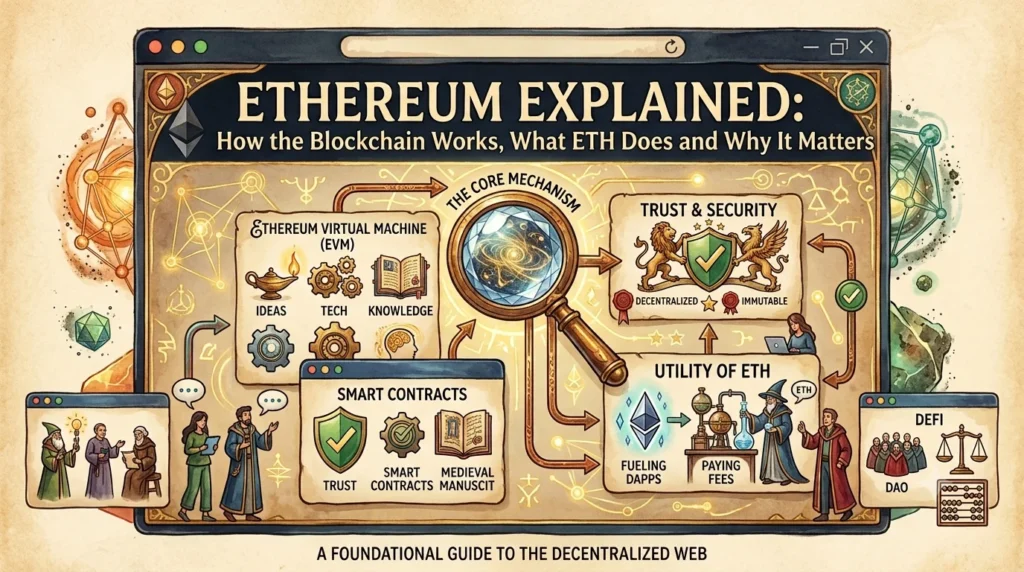
Ethereum Explained: How the Blockchain Works, What ETH Does and Why It Matters.
Introduction
Ethereum is one of the best-known blockchain platforms, but its purpose goes beyond sending and receiving cryptocurrency. It gives developers the tools to build applications that use shared digital records and programmable agreements called smart contracts.
Ether (ETH), Ethereum’s native cryptocurrency, plays a central role in this ecosystem. People use ETH to transfer value, pay transaction fees, participate in staking and interact with decentralised applications. Meanwhile, developers use Ethereum’s infrastructure to create financial services, digital collectibles, games and other blockchain-based products.
However, Ethereum and ETH mean different things. Ethereum refers to the blockchain network and its technology, whereas ETH refers to the digital asset that powers many network activities. Understanding this distinction makes the wider cryptocurrency ecosystem easier to follow.
This guide explains Ethereum in straightforward language. You’ll learn how its blockchain works, what people use ETH for, how gas fees operate, what staking involves and which risks users should consider before exploring the network.
Quick Answer: What Is Ethereum?
| Question | Answer |
|---|---|
| What is Ethereum? | A decentralised blockchain platform that supports cryptocurrency transactions and programmable applications. |
| What is ETH? | Ether, Ethereum’s native cryptocurrency. |
| How does Ethereum work? | Network participants maintain and verify blockchain data through a proof-of-stake consensus mechanism. |
| What are smart contracts? | Programs that execute instructions when users or other contracts interact with them. |
| What is ETH used for? | Paying network fees, transferring value, staking and using blockchain applications. |
| What is Ethereum staking? | Committing ETH to help secure the network through its proof-of-stake system. |
| What are gas fees? | Charges that cover the computational resources required to process Ethereum transactions. |
| Is Ethereum an investment? | ETH is a crypto asset people can buy and sell, but its market price can fluctuate sharply. |
1. What Is Ethereum?
Ethereum is a decentralised blockchain platform that lets people transfer digital assets and interact with applications without relying entirely on a central organisation to maintain the system.
A blockchain acts as a shared digital record. It organises transactions into connected blocks, while network participants maintain and verify the data according to agreed rules.
Ethereum extends this concept by supporting programmable applications. Developers can create smart contracts that follow predefined instructions, allowing applications to carry out specific operations on the blockchain.
The official Ethereum documentation describes Ethereum as a platform for digital assets and decentralised applications. Its programmable design distinguishes it from networks that focus primarily on cryptocurrency transfers.
Why Was Ethereum Created?
Ethereum extends blockchain technology beyond basic digital payments. Its design allows developers to create applications with rules that the network can execute through smart contracts.
For example, a developer might build a decentralised exchange, a digital collectible marketplace or a lending application. Users can then interact with these services through compatible wallets and interfaces.
At first glance, a blockchain application may look like an ordinary website. However, some operations rely on smart contracts and blockchain records rather than a company’s private database alone.
Is Ethereum Decentralised?
Ethereum operates through a distributed network of participants rather than a single organisation that controls the entire blockchain.
Validators help process transactions and participate in consensus. Meanwhile, nodes independently check blockchain data against the protocol’s rules.
However, the level of decentralisation can differ between applications. A project may depend on a central company, an administrator, a website or a third-party service even when it uses Ethereum underneath. Therefore, users should evaluate both the blockchain and the application they plan to use.
2. Ethereum vs Ether (ETH)
Ethereum and Ether are closely related, but they describe different things.
Ethereum refers to the blockchain network, its protocol and the broader platform for decentralised applications.
Ether (ETH) is the network’s native cryptocurrency. People use ETH to pay transaction fees, transfer value and participate in other activities across the Ethereum ecosystem.
Think of Ethereum as a digital infrastructure system and ETH as one of the resources people use within that system. Although this comparison simplifies the technology, it helps explain the distinction.
What Gives ETH Its Utility?
ETH serves several practical purposes:
- Transaction fees: Users generally need ETH to pay gas fees for transactions on Ethereum Mainnet.
- Value transfers: People can send ETH to compatible wallet addresses.
- Staking: Validators commit ETH to participate in the network’s proof-of-stake consensus.
- Decentralised finance: Users can employ ETH in supported lending, borrowing, trading and liquidity applications.
- Digital asset markets: Some marketplaces accept ETH for purchases and related transactions.
The exact role of ETH depends on the service. An application might also support stablecoins, other tokens or separate payment methods.
Is ETH the Same as Every Ethereum Token?
No. ETH is Ethereum’s native asset, while developers create many other tokens through smart contracts.
For example, the ERC-20 standard lets developers create fungible tokens that compatible applications can recognise and handle. Depending on their design, these tokens may serve governance, utility or other purposes.
Creating a token on Ethereum does not mean the network endorses its issuer or guarantees its value. Users should investigate each project independently before interacting with it.
3. How Does Ethereum Work?
Ethereum combines several technical components to maintain its blockchain and process transactions. Understanding these basics helps explain what happens when someone sends ETH or uses a decentralised application.
Blockchain Records
When a user submits a transaction, Ethereum checks it against the network’s rules. The network can then include a valid transaction in a block, adding it to the blockchain’s recorded history.
Cryptographic techniques link blocks and help participants detect unauthorised changes. Nodes can independently verify transaction data and the current state of the system.
Although blockchain activity often remains publicly visible, it does not automatically reveal every user’s real-world identity. Ethereum addresses are generally pseudonymous, but outside information can sometimes link an address to a person.
Nodes
Nodes run Ethereum client software and help maintain or verify blockchain information.
Different nodes perform different operational roles. Some focus on independently verifying the chain, while others provide data to applications and users. Validators also rely on node infrastructure, but running an ordinary node does not automatically make someone a validator.
Proof of Stake
Ethereum uses proof of stake to secure its network and reach consensus. In September 2022, the network completed its transition from proof of work to proof of stake in an event known as The Merge.
Validators commit ETH as stake and participate in proposing or attesting to blocks. The protocol rewards eligible participation and penalises certain failures or dishonest actions.
The official Ethereum proof-of-stake guide explains how validators help maintain the blockchain.
What Happens When You Send ETH?
A typical ETH transfer follows these steps:
- The sender enters the recipient’s address and the amount to transfer.
- A compatible wallet prepares the transaction.
- The sender authorises the transaction using the account’s private key.
- The wallet broadcasts the transaction to the network.
- Ethereum’s software checks the transaction against its rules.
- Validators process it through the consensus system, and the network records it in a block.
The sender also pays the applicable transaction fee. If the transaction interacts with a smart contract instead of simply transferring ETH, the network may need to perform additional computational operations.
4. What Are Smart Contracts?
Smart contracts are programs that developers deploy on a blockchain. They execute instructions when users or other contracts interact with them and meet the required conditions.
A conventional contract often describes obligations in legal language. By contrast, a smart contract contains executable software that carries out specific programmed instructions. It can automate certain processes, but it does not replace every legal agreement or remove the need for human judgement.
How Do Smart Contracts Work?
Imagine a digital marketplace where a customer wants to purchase a digital item.
A developer might create a smart contract that defines how the marketplace handles payment and transfers the item. When a valid transaction meets the contract’s conditions, the software executes the programmed instructions.
The outcome depends on the code, the permissions it uses and the wider application’s design. A bug or flawed rule can cause serious problems, which makes testing and security reviews important.
Common Uses of Smart Contracts
Decentralised finance (DeFi): Smart contracts support exchanges, lending protocols, borrowing markets and other financial applications.
Non-fungible tokens (NFTs): Developers use smart contracts to create and manage unique digital tokens.
Gaming: Blockchain games may use contracts to manage selected assets, rewards or in-game transactions.
Decentralised organisations: Some projects use smart contracts to manage voting, governance or treasury operations.
Digital marketplaces: Contracts can automate parts of purchases, asset transfers and other transactions.
These applications vary in design and risk. Even when a smart contract executes exactly as programmed, the wider project may still face security, liquidity or governance problems.
5. What Is ETH Used For?
ETH supports Ethereum’s operation and enables several activities across the ecosystem.
Sending and Receiving Cryptocurrency
People can transfer ETH between compatible wallets and addresses. Depending on their needs, they may use it to move value between individuals, businesses and cryptocurrency services.
Before sending a transfer, verify the recipient address and the selected network. Sending assets to the wrong destination can cause permanent loss.
Paying Gas Fees
Ethereum charges users for the computational resources needed to process transactions. On Ethereum Mainnet, users generally pay these fees in ETH.
A simple transfer typically requires less computation than a complex smart-contract interaction. As a result, two transactions can incur different fees even when they use the same network.
Participating in Decentralised Finance
DeFi applications let users access services such as lending, borrowing, token exchanges and liquidity provision. ETH may serve as a traded asset or collateral in supported protocols.
However, these activities involve risks, including smart-contract vulnerabilities, liquidation, price volatility and limited liquidity. Decentralised technology does not automatically make a financial service safe.
Buying Digital Collectibles
Some NFT marketplaces accept ETH for digital collectibles and related transactions.
However, not every NFT uses ETH for payment. In addition, owning an NFT does not automatically grant copyright or unrestricted commercial rights to the underlying artwork. The relevant licence, contract and applicable law determine those rights.
Staking
ETH holders can participate in staking through different arrangements. Some operate their own validator infrastructure, while others use supported pooled or service-based options.
Each method involves different requirements, fees, technical responsibilities and risks. Staking does not function like a guaranteed savings account, and rewards cannot eliminate the risk of losing money.
6. Understanding Ethereum Gas Fees
Ethereum uses gas to measure the computational work required to execute transactions and smart-contract operations. Users pay gas fees for the network resources their transactions consume.
The fee depends on the gas used and the applicable gas price. Network demand can also influence the price users pay for each unit of gas.
How Are Gas Fees Calculated?
On Ethereum Mainnet, the transaction fee generally depends on the gas consumed and the effective gas price.
The fee mechanism includes a base fee and, where applicable, a priority fee that can encourage validators to include a transaction promptly.
Consider an illustrative example. Suppose a transaction consumes 21,000 units of gas and the effective price reaches 12 gwei per unit.
The calculation would be:
21,000 × 12 gwei = 252,000 gwei = 0.000252 ETH.
This example demonstrates the calculation; it does not represent a current Ethereum fee. Actual gas usage and prices change with transaction type and network conditions.
For more details, consult the official Ethereum gas and fees guide.
Why Do Gas Fees Change?
Several factors influence transaction costs:
- Network demand when you submit the transaction.
- The complexity of the transaction.
- The computational operations required.
- The fee settings your wallet selects.
- Whether you use Ethereum Mainnet or a Layer 2 network.
During busy periods, users may face higher fees. Complex smart-contract interactions can also consume more gas than simple transfers.
How Can You Manage Gas Costs?
Try these practical steps to manage transaction expenses:
- Check estimated fees: Review your wallet’s estimate before confirming a transaction.
- Choose an appropriate network: If an application supports a suitable Layer 2 network, compare the costs and requirements.
- Avoid unnecessary transactions: Reduce redundant operations when the application allows it.
- Review transaction details: Understand what you are signing and which assets or permissions the transaction affects.
- Question urgent demands: A website that pressures you to act immediately may be trying to rush you into a mistake.
Gas fees help allocate Ethereum’s computational resources. Because the network does not charge one fixed rate for every transaction, the final cost can vary.
7. What Is Ethereum Staking?
Ethereum staking involves committing ETH to help secure the network’s proof-of-stake system.
Validators check transactions, attest to blocks and may propose new blocks. The protocol rewards eligible participation and applies penalties for certain failures or dishonest behaviour.
Running a Validator
A solo validator operates the required software and infrastructure and deposits 32 ETH into Ethereum’s validator deposit contract. This amount applies to the standard solo-validator setup; people do not need 32 ETH simply to own ETH or use Ethereum.
Running a validator requires technical knowledge, reliable equipment and an understanding of protocol risks. Poor performance or prohibited behaviour can trigger penalties, including the loss of some staked ETH.
Staking Through a Service
Some users prefer staking services or pooled arrangements because they do not want to operate a validator themselves.
These options may offer different minimum amounts, fees, withdrawal conditions and counterparty risks. Certain services also issue tokens that represent staking positions, adding further considerations.
Before committing funds, review the provider’s terms, security practices and withdrawal process.
Are Staking Rewards Guaranteed?
No. Rewards vary, and staking carries risks. Network participation, validator performance, service fees and the chosen staking method can all affect the outcome.
Some arrangements also involve lock-up periods, liquidity limitations or additional smart-contract risks. Treat advertised annual rates as estimates rather than guarantees, and remember that ETH’s market value can fall.
8. Ethereum Layer 2 Networks and Scalability
As blockchain applications grow, the network must balance transaction capacity, cost, security and decentralisation. Ethereum’s ecosystem uses Layer 2 networks to help address these challenges.
Layer 2 networks process transactions through their own execution environments while relying on Ethereum in different ways for settlement, security or data availability. Each network has its own design and assumptions.
Why Are Layer 2 Networks Important?
Layer 2 networks can offer lower transaction costs and a faster experience for supported activities. They can make blockchain applications more practical for everyday transfers, gaming, trading and other use cases.
Nevertheless, lower fees do not eliminate every risk. Different networks use different security models, bridge mechanisms, upgrade controls and withdrawal processes.
What Should Users Check Before Using a Layer 2?
Before transferring assets, confirm the following:
- Does your wallet and application support the destination network?
- Does the network support the token you intend to transfer?
- What fees apply to the transfer and later transactions?
- Will you need a bridge or third-party service?
- How can you withdraw funds back to Ethereum Mainnet?
- What security and governance assumptions does the network use?
Always verify the network in your wallet before confirming a transfer. If you send assets through the wrong route or to an incompatible destination, recovery may prove difficult or impossible.
9. Ethereum vs Bitcoin
Ethereum and Bitcoin both use blockchain technology, but they serve different purposes and follow different technical designs.
Bitcoin primarily focuses on a decentralised digital currency and monetary network. Ethereum also supports value transfers, while offering a programmable platform for smart contracts and decentralised applications.
| Feature | Ethereum | Bitcoin |
|---|---|---|
| Native asset | Ether (ETH) | Bitcoin (BTC) |
| Consensus mechanism | Proof of stake | Proof of work |
| Main capabilities | Transfers, smart contracts and decentralised applications | Transfers and a blockchain built around Bitcoin’s monetary system |
| Programmability | Supports general-purpose smart-contract execution | Uses Bitcoin Script, with a more constrained scripting model |
| Transaction fees | Vary with gas usage and network demand | Vary with transaction characteristics and network demand |
| Scaling ecosystem | Includes Layer 2 networks and rollups | Includes scaling approaches such as the Lightning Network |
| Common uses | ETH transfers, DeFi, NFTs, staking and application interactions | Value transfers, payments and savings-oriented use cases |
Neither network suits every purpose. Their technical designs reflect different priorities, so users should assess the specific application or activity they care about.
10. Benefits and Limitations of Ethereum
Ethereum offers useful infrastructure for digital applications, but its advantages come with limitations.
Potential Benefits
Programmable applications: Smart contracts let developers build services that follow predefined, blockchain-executed rules.
Public verification: Users can inspect blockchain activity through compatible block explorers and examine recorded transactions.
A broad application ecosystem: Ethereum supports financial applications, digital assets, marketplaces and developer tools.
Native staking mechanism: Eligible ETH holders can help secure the network directly or through supported staking arrangements.
Layer 2 development: Scaling networks offer alternative ways to use Ethereum-related applications and may lower costs for supported transactions.
Limitations and Risks
Price volatility: ETH can experience substantial price changes. Its market value is not guaranteed.
Transaction costs: Mainnet fees can rise during busy periods. Certain failed transactions may also consume gas.
Smart-contract vulnerabilities: Bugs, flawed economic designs or compromised administrative controls can expose users to losses.
User responsibility: Losing access to a wallet or sending funds to an incorrect address can result in permanent loss.
Complexity: Wallets, token approvals, network selection and bridging can confuse beginners.
Regulatory uncertainty: Laws and tax obligations differ between countries and may change. Users need to consider the rules that apply to their circumstances.
Ethereum’s capabilities make it useful for many applications, but the network cannot guarantee that every project will succeed, remain secure or deliver financial returns.
11. Is Ethereum Safe to Use?
Ethereum includes security mechanisms at the protocol level, but safe usage depends on more than the blockchain itself. Wallet protection, application design, user decisions and third-party services all matter.
Protect Your Recovery Phrase
A wallet’s recovery phrase or seed phrase can give someone access to the assets that wallet controls. Anyone who obtains it may take control of your funds.
Never share the phrase with a website, support agent or stranger. Also, avoid storing it in screenshots or other easily accessible digital locations.
Verify Addresses and Networks
Before sending ETH, carefully compare the recipient address with the intended destination. Confirm that your wallet uses the correct network.
Blockchain transactions generally cannot be reversed through a central support team. If you send funds to the wrong address, you may have no reliable way to recover them.
Be Careful With Smart-Contract Permissions
Some applications ask users to approve token spending or grant other permissions. Read the transaction details before signing, and avoid granting broader permissions than necessary.
If you stop using an application, review whether you should revoke any active approvals. Use a legitimate tool and understand the consequences before changing permissions.
Recognise Common Crypto Scams
Fraudsters may impersonate wallet support, advertise fake giveaways or offer to recover lost funds in exchange for a fee.
The official Ethereum security guide explains how to protect wallets, identify phishing attempts and avoid common scams. Ethereum is a decentralised network, not a company with a central support desk that can reverse transactions or retrieve funds on demand.
Never send ETH to someone who claims they need it to verify your wallet. Likewise, never reveal your recovery phrase to receive assistance.
12. Final Thoughts
Ethereum has developed into a programmable blockchain platform that supports cryptocurrency transfers, smart contracts and a wide range of decentralised applications. Its native asset, ETH, plays a central role in paying transaction fees and participating in the proof-of-stake system.
To understand Ethereum, start with a few essential concepts: the difference between Ethereum and Ether, the purpose of smart contracts, the role of validators and the reason transactions require gas fees. Layer 2 networks provide additional options for users who want different cost and performance trade-offs.
However, Ethereum also carries risks. Cryptocurrency prices can change sharply, transactions are generally irreversible, and smart contracts or third-party services may contain vulnerabilities. Anyone exploring the ecosystem should protect their wallet, verify transaction details and research applications before committing funds.
With a clear understanding of Ethereum’s technology, uses and limitations, readers can make better-informed decisions about whether the network fits their interests, development projects or financial goals.
What is Ethereum in simple words?
Ethereum is a blockchain network that lets people transfer digital assets and use applications powered by smart contracts. Its programmable design supports much more than cryptocurrency transfers.
What is the difference between Ethereum and ETH?
Ethereum is the blockchain platform, while ETH, or Ether, is its native cryptocurrency. People use ETH to pay transaction fees, transfer value and participate in staking.
Where can I learn more about Ethereum?
The official Ethereum website provides educational material about the blockchain, ETH, wallets, staking, gas fees and security. Beginners can start with the introductory guides before exploring smart contracts or decentralised applications.
Is Ethereum the same as a stablecoin?
No. ETH is Ethereum’s native cryptocurrency, and its market price can fluctuate substantially. Stablecoins aim to maintain a value linked to another asset, such as a currency. Their stability depends on their design, reserves, issuer and other factors, so a stablecoin is not automatically risk-free.