Let’s Buy Spirit Explained: From Viral Campaign to a New Airline.
Introduction
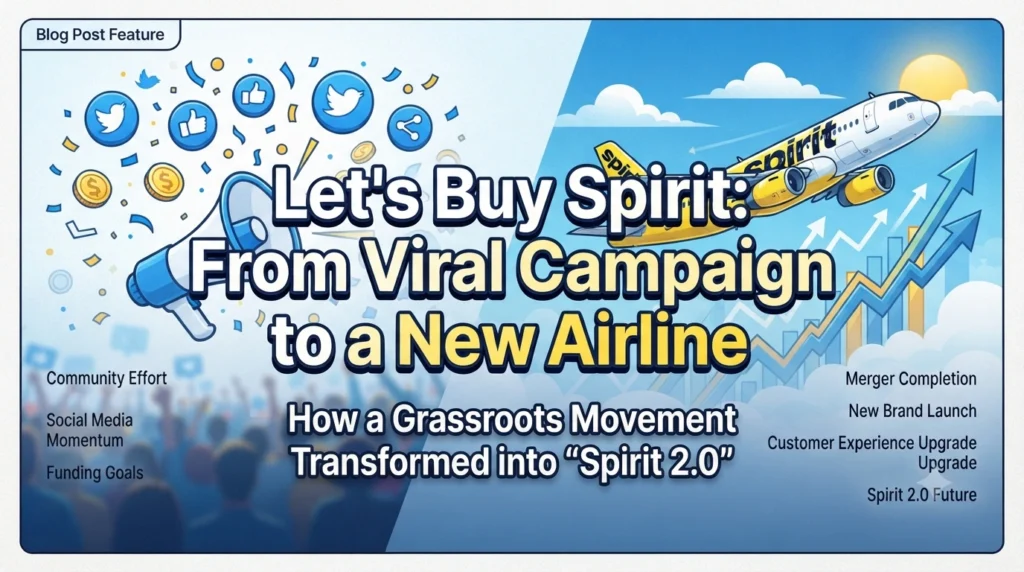
Let’s Buy Spirit became one of the internet’s most unusual airline stories in 2026. Shortly after Spirit Airlines stopped flying, a social-media-driven campaign asked a simple question: what if ordinary travelers collectively bought the airline?
Hunter Peterson launched the idea online under the Spirit 2.0 concept. Instead of relying entirely on traditional airline investors, the campaign proposed bringing together passengers, supporters, and potential community owners.
Interest grew rapidly. Thousands of people submitted non-binding pledges, and media coverage pushed the idea far beyond its original social-media audience. However, a pledge was not the same as money deposited for an airline acquisition.
The story has since taken another turn. After the effort moved away from acquiring Spirit Airlines, Peterson and his team began developing a new airline concept from the ground up under First Jet Air.
So what exactly was Let’s Buy Spirit, and what does it mean now?
What Is Let’s Buy Spirit?
Let’s Buy Spirit was a grassroots campaign created after Spirit Airlines ceased operations on May 2, 2026.
Spirit Aviation Holdings announced an immediate orderly wind-down and canceled all remaining flights. The airline said rising oil prices and other financial pressures had severely affected its outlook and that it had no additional funding available to continue operations.
Hunter Peterson responded by proposing that a large group of ordinary people could collectively support an attempt to acquire and revive the airline.
The idea quickly became known as Spirit 2.0 or Let’s Buy Spirit.
Rather than presenting it as a conventional airline acquisition backed by a few wealthy investors, the campaign focused on community participation.
Quick facts
| Topic | Details |
|---|---|
| Campaign | Let’s Buy Spirit |
| Initial concept | Collectively acquire and revive Spirit Airlines |
| Founder associated with campaign | Hunter Peterson |
| Early project name | Spirit 2.0 |
| Initial funding mechanism | Non-binding pledges |
| Spirit Airlines shutdown | May 2, 2026 |
| Original vision | Community-supported airline ownership |
| Later direction | Building a new airline |
| Current company associated with new direction | First Jet Air |
| Industry | Airlines and aviation |
The distinction between pledges and actual investment is especially important when researching the campaign.
Why Did Let’s Buy Spirit Start?
Spirit Airlines had become one of America’s best-known ultra-low-cost carriers before its shutdown.
For years, its business model focused on low base fares combined with additional charges for optional services. The airline built a large customer base among travelers looking for inexpensive flights.
By 2026, however, Spirit faced severe financial problems.
The company had previously entered bankruptcy proceedings, and its financial situation deteriorated further as operating pressures increased. Spirit ultimately announced that it would wind down operations immediately on May 2.
That sudden shutdown created an unusual opportunity for an internet-driven idea.
Peterson proposed that instead of simply allowing the airline to disappear, consumers could attempt to collectively acquire it.
The original concept was intentionally simple: if enough people contributed relatively small amounts, the combined capital could potentially become significant.
How Did Spirit 2.0 Become Viral?
The campaign grew primarily through social media.
Peterson’s initial idea attracted substantial attention on platforms such as TikTok, Instagram and other social networks. Coverage from technology and business publications helped push the story beyond aviation enthusiasts.
Early reports showed tens of thousands of people registering interest.
At one point, reports cited more than 247,000 pledges representing approximately $214 million. Other campaign updates later showed substantially larger figures. These numbers represented expressions of interest rather than cash sitting in an acquisition account.
That difference matters.
A website displaying hundreds of millions of dollars in pledges does not mean the organizers have hundreds of millions of dollars available to purchase an airline.
Pledge vs. investment
A pledge generally represents an expression of willingness to contribute under proposed conditions.
An investment involves an actual financial transaction subject to applicable legal and offering requirements.
The early Let’s Buy Spirit campaign was based on non-binding pledges rather than completed investments. TechCrunch specifically reported that the early figures were not actual money collected.
What Was the Spirit 2.0 Ownership Idea?
One of the most interesting parts of the proposal was its approach to ownership.
Peterson discussed the possibility of a community-oriented ownership structure inspired by organizations where customers or supporters have a meaningful ownership role.
The Green Bay Packers model was frequently referenced in coverage of the idea. The concept was to create a business in which ordinary participants could have a relationship with the airline beyond simply purchasing tickets.
That vision created a different question from the usual airline investment pitch:
Could an airline be designed around its passengers and community rather than only conventional shareholders?
Answering that question in practice is considerably more complicated than generating public interest.
Airlines require substantial capital, regulatory approvals, aircraft, trained personnel, operational systems, airport access, insurance and safety infrastructure.
Why Buying Spirit Airlines Was So Difficult
Acquiring an airline is not the same as buying an ordinary consumer company.
An airline acquisition can involve:
- Aircraft and leases
- Airport slots and gates
- Operating certificates
- Regulatory approvals
- Labor agreements
- Maintenance infrastructure
- Insurance
- Reservations and technology systems
- Brand and intellectual property
- Debt and other liabilities
- Working capital
- Safety and operational compliance
Spirit’s shutdown also changed the situation dramatically.
Once the company entered an orderly wind-down, assets could be sold or otherwise handled through the bankruptcy process. A potential buyer therefore had to understand exactly which assets were available and what obligations came with them.
The campaign’s original ambition therefore faced both financial and legal challenges.
Did Let’s Buy Spirit Actually Buy Spirit Airlines?
No.
The original campaign did not ultimately acquire Spirit Airlines.
By the middle of 2026, the project had moved toward a different strategy. The effort eventually shifted away from purchasing Spirit and toward creating a new airline.
First Jet Air’s own public description says the project started as an attempt to buy Spirit but later decided to build an airline from the ground up.
That is an important update for anyone searching for information about Let’s Buy Spirit today.
The campaign should not be described as though it successfully purchased Spirit Airlines.
What Is First Jet Air?
First Jet Air is the newer airline concept that emerged from the original movement.
Its public description presents the company as an attempt to build an airline around the people who use it rather than simply revive Spirit Airlines.
The company’s public profile says the project moved away from purchasing Spirit in June 2026 and began working toward a new airline from the ground up.
That means the current story is no longer simply:
“Let’s buy Spirit Airlines.”
It has become closer to:
“Let’s build a new airline with the community involved.”
This distinction is essential when researching the project today.
How Is the New Airline Concept Different?
The original Let’s Buy Spirit idea depended on acquiring an existing airline.
The newer First Jet Air concept starts from scratch.
| Original Let’s Buy Spirit | New First Jet Air direction |
|---|---|
| Acquire Spirit Airlines | Build a new airline |
| Revive an existing carrier | Develop a new operation |
| Focus on Spirit’s existing assets | Create a new airline structure |
| Community-backed acquisition concept | Community-oriented airline concept |
| Spirit 2.0 branding | First Jet Air |
| Acquisition challenges | Startup and regulatory challenges |
Starting over does not eliminate the difficult parts of aviation.
Instead, it changes the nature of those challenges.
A new airline must still address regulatory certification, aircraft, financing, airport relationships, staffing, safety systems, technology and day-to-day operations.
Is Let’s Buy Spirit Still Active?
The original acquisition concept is no longer the main direction.
Current public information associated with First Jet Air describes the project as having moved from purchasing Spirit to building a new airline.
Recent reporting has similarly described the campaign’s evolution into a broader “Let’s Build an Airline” concept.
For readers searching the original phrase, this can make the current information confusing.
Older articles may discuss a planned acquisition of Spirit. Newer updates focus on building a completely different carrier.
Both can be accurate for their respective points in time.
What Makes the Campaign Interesting?
The biggest feature of Let’s Buy Spirit was its ability to turn a social-media idea into a serious business discussion.
Normally, airline ownership is associated with institutional investors, corporations, private equity groups and large financial transactions.
Spirit 2.0 introduced a different question: could a large online community become the foundation for an airline?
The campaign demonstrated that social media can rapidly gather people around an unusual commercial idea.
However, attention and capital are different things.
An online community can provide visibility, potential customers and supporters. Turning that community into a legally structured, adequately funded airline requires another level of planning.
What Are the Biggest Challenges for First Jet Air?
Building an airline from scratch creates several major challenges.
1. Regulatory approval
Airlines operate in a highly regulated environment.
A new carrier needs appropriate regulatory authorization and must demonstrate that it can operate safely and reliably.
2. Aircraft
An airline needs aircraft that meet its operational requirements.
That involves acquisition or leasing costs, maintenance, crew requirements, fuel consumption and fleet planning.
3. Capital
Aircraft represent only one part of airline startup costs.
A new carrier also needs money for employees, technology, insurance, airport operations, maintenance, marketing and working capital.
4. Airport access
A route network requires suitable airports, gates, facilities and operational arrangements.
Popular airports can be particularly challenging because capacity is limited.
5. Experienced management
Running an airline requires specialized knowledge.
Operations, safety, maintenance, scheduling, revenue management, regulatory compliance and customer service all require experienced teams.
6. Customer economics
Low fares can attract customers, but the airline still needs a sustainable revenue model.
A new carrier must balance ticket prices, ancillary revenue, operating costs and customer expectations.
Is Let’s Buy Spirit a Crowdfunding Investment?
People should distinguish between following the campaign, making a pledge, and making a regulated investment.
The original Spirit 2.0 campaign prominently used non-binding pledges rather than treating every early supporter as a conventional investor. TechCrunch reported that the early pledge figures did not represent actual money collected.
Any later investment opportunity should be evaluated based on its actual legal offering documents, issuer information, terms, risks and applicable securities regulations.
A social-media post or pledge counter should not be treated as proof that an investment opportunity is guaranteed or that funds are already secured.
What Should Readers Check Before Supporting an Airline Startup?
Anyone considering financial participation in an airline startup should look beyond social-media enthusiasm.
Check the legal structure
Find out which legal entity is raising money and what ownership rights investors receive.
Read the offering documents
Look for information about risks, fees, dilution, voting rights, use of funds and exit limitations.
Understand what the money buys
A contribution could represent equity, a membership, a donation, a reservation-related benefit or another structure.
Those are not interchangeable.
Look for regulatory information
Airline operations require extensive regulatory compliance.
Separate announcements from completed milestones
Statements about plans, negotiations or potential partnerships do not necessarily mean those milestones have been completed.
Consider the risk
Airline startups can require significant capital before generating meaningful revenue.
Anyone considering an investment should assess whether they can afford to lose the money.
Let’s Buy Spirit vs. Spirit Airlines
It is also useful to understand that the two names refer to very different things.
| Factor | Let’s Buy Spirit | Spirit Airlines |
|---|---|---|
| Type | Grassroots campaign | Former U.S. airline |
| Purpose | Originally proposed acquiring Spirit | Operated commercial flights |
| Founder/creator | Hunter Peterson | Corporate management |
| Status in 2026 | Evolved toward a new airline project | Operations wound down |
| Main concept | Community-supported ownership | Ultra-low-cost airline |
| Flights | Did not operate Spirit flights | Flights canceled May 2, 2026 |
| Current direction | First Jet Air | Wind-down/liquidation process |
Spirit Airlines itself announced that all flights were canceled when its orderly wind-down began on May 2, 2026.
Why Does the Story Matter for Aviation?
The Let’s Buy Spirit story illustrates how consumer communities can influence business conversations.
Travelers often complain about airline prices, fees, route reductions and customer experience. Spirit’s disappearance created an especially visible example because the carrier had built its identity around low-cost travel.
The campaign effectively transformed that frustration into a business experiment.
Whether the new airline model succeeds is a separate question. The more immediate significance is that a social-media audience became involved in discussing airline ownership, financing and operations in a way that is unusual for the industry.
Frequently Asked Questions About Let’s Buy Spirit
What is Let’s Buy Spirit?
Let’s Buy Spirit was a grassroots campaign launched after Spirit Airlines stopped operating in May 2026. It proposed using community support to pursue an acquisition and revival of the airline.
Who started Let’s Buy Spirit?
The campaign was started by Hunter Peterson, a voice actor and online creator who promoted the Spirit 2.0 idea through social media.
Did Let’s Buy Spirit purchase Spirit Airlines?
No. The original acquisition effort did not result in the purchase of Spirit Airlines. The project later shifted toward creating a new airline.
What happened to Spirit Airlines?
Spirit Airlines began an immediate orderly wind-down on May 2, 2026, canceling all flights. The company cited financial pressures, including higher oil prices and a lack of additional funding.
What is Spirit 2.0?
Spirit 2.0 was the name used for the community-driven effort to potentially revive Spirit Airlines after its shutdown. The concept later evolved beyond the original acquisition proposal.
What is First Jet Air?
First Jet Air is the newer airline project associated with the movement. Its public description says the team moved away from purchasing Spirit and decided to build a new airline from the ground up.
Were the millions reported by the campaign actual cash?
Early figures reported by the campaign represented non-binding pledges rather than money already collected for an airline acquisition.
Is First Jet Air already operating flights?
The project is a new airline venture rather than a continuation of Spirit Airlines’ existing flight operation. Readers should check the company’s latest official announcements for regulatory, investment and launch milestones.
Final Takeaways
Let’s Buy Spirit started with a surprisingly simple idea: could ordinary travelers collectively buy a major airline?
The concept went viral after Spirit Airlines ceased operations on May 2, 2026. Large numbers of people submitted non-binding pledges, turning a social-media thought experiment into a widely discussed aviation story.
The original acquisition plan ultimately did not result in the purchase of Spirit Airlines.
Instead, the project evolved into an attempt to create a new airline. First Jet Air now describes itself as a people-focused airline project built from the ground up.
For anyone searching Let’s Buy Spirit the most important point is therefore the timeline: Spirit Airlines shut down, Spirit 2.0 attempted to rally community support for an acquisition, and the project later shifted toward building a new airline.
The next stage depends on the practical realities of aviation: financing, regulation, aircraft, airport access, experienced personnel and sustainable operations.