
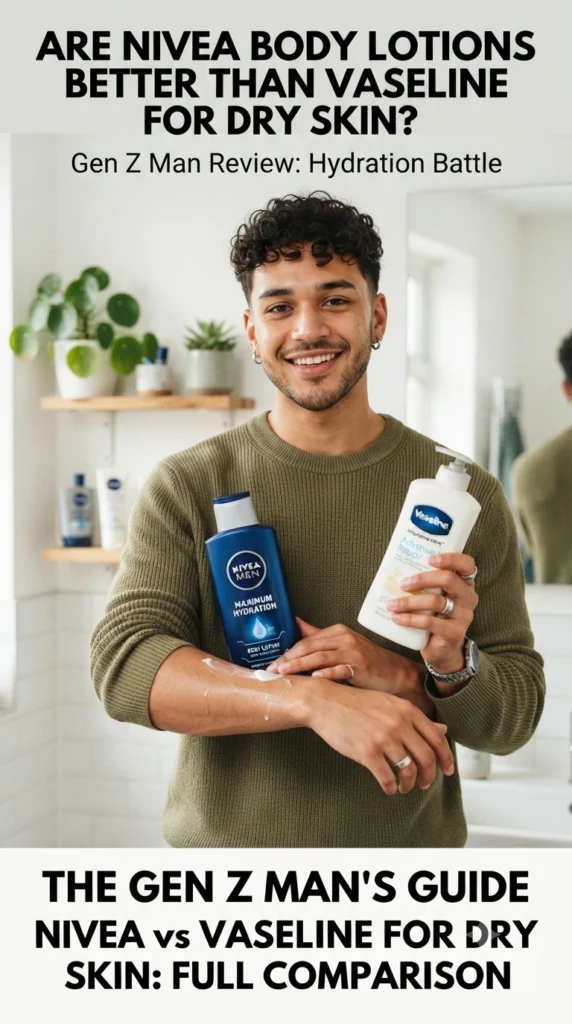
I Am a GenZ Man. Are Nivea Body Lotions Better Than Vaseline for Dry Skin?
Introduction
Let’s be honest: most guys don’t want a 10-step body-care routine.
If your legs feel dry after a shower, your elbows look rough, or your skin becomes flaky during winter, you probably want one simple answer: Which body lotion should I use?
That is where the NIVEA vs Vaseline question comes in.
Both brands are widely associated with moisturization, but they approach body care through different types of formulas. NIVEA has a large selection of lotions designed around different skin needs, while Vaseline offers lotions alongside products centered around petroleum jelly and moisture retention.
So, are NIVEA body lotions better than Vaseline?
There isn’t one answer that applies to every person.
The more useful approach is to understand what your skin needs, what type of product you’re buying, and how you plan to use it.
For a Gen Z man, that can mean considering gym showers, hot weather, winter dryness, fragrance preferences, product texture, budget, convenience and how much time you realistically want to spend on skincare.
The Real Difference Is Not Simply NIVEA vs Vaseline
Before comparing the brands, there is an important distinction to make.
A brand is not a formula.
NIVEA sells multiple body moisturizers. Vaseline also sells multiple lotions, creams and jelly products.
A lightweight Vaseline lotion shouldn’t automatically be compared with petroleum jelly. Likewise, a rich NIVEA dry-skin formula shouldn’t automatically represent every NIVEA body lotion.
This is why two people can use products from the same brand and have completely different experiences.
One person may love a lightweight lotion because it absorbs quickly.
Another may prefer something richer because their elbows and legs remain dry after using a lightweight product.
The product’s ingredients, texture and intended use matter more than simply seeing the brand name on the bottle.
What Does Your Skin Actually Need?
A moisturizer generally helps address dryness through different mechanisms.
Some ingredients attract water toward the skin. These are called humectants.
Others help soften and smooth the skin. These are emollients.
Another group helps reduce water loss by forming a protective layer. These are occlusives.
You don’t need to memorize complicated chemistry, but understanding these three categories makes comparing products much easier.
Humectants
Glycerin is a common example.
NIVEA describes glycerin as a humectant that helps attract and hold moisture.
Emollients
These help make the skin feel smoother and softer by filling or smoothing spaces on the skin surface.
Occlusives
Petrolatum, or petroleum jelly, is a classic example.
Vaseline describes petroleum jelly as an occlusive that helps lock in moisture and support the skin barrier.
A good moisturizer can combine several of these approaches.
Where NIVEA Can Fit Into a Men’s Routine
NIVEA’s body-care range includes products designed for different levels of dryness and preferences.
Its current dry-skin guidance recommends applying a rich moisturizer while the skin is still slightly damp after showering or bathing. NIVEA also offers a fragrance-free Repair & Care Body Lotion formulated with glycerin and panthenol for dry and sensitive skin.
That makes NIVEA particularly relevant if you want:
- A conventional body lotion
- Something easy to spread
- Different texture choices
- A product for everyday use
- A richer option for dry skin
- A fragrance-free option in the range
The exact experience still depends on which NIVEA product you choose.
You shouldn’t assume every bottle has the same ingredients or skin benefits.
Where Vaseline Can Fit Into a Men’s Routine
Vaseline is especially interesting because its range covers more than traditional body lotion.
Its current Indian product range includes lotions, body creams, protecting jelly and sun-protection products. The range can also be filtered for dry and very dry skin.
That gives you several options.
For example, you might use a lotion over larger areas of the body and reserve petroleum jelly for areas that become exceptionally dry.
Vaseline’s own dry-skin guidance describes products containing glycerin and petroleum jelly as useful for naturally dry skin. It also recommends short, warm showers and avoiding habits that can strip natural oils.
So Vaseline doesn’t have to mean:
“I’m using a thick layer of jelly everywhere.”
Modern Vaseline body-care products include different textures and purposes.
The Texture Test: What Do You Actually Like?
Here’s a factor that skincare articles sometimes overlook.
You are more likely to use a moisturizer consistently if you like how it feels.
Imagine buying an extremely rich moisturizer.
You apply it once.
It feels too heavy.
You stop using it.
Technically, you bought a moisturizer, but practically, it never became part of your routine.
Now imagine a lighter lotion that you apply every day after showering.
Consistency may matter more to your routine than chasing the richest possible product.
When comparing NIVEA and Vaseline, ask:
- Does it spread easily?
- Does it feel sticky?
- Does it leave a noticeable film?
- How quickly does it absorb?
- Does the fragrance bother you?
- Can you comfortably wear clothes afterward?
- Do you like using it every day?
These questions can be more useful than simply asking which brand is “better.”
What If Your Skin Is Only Slightly Dry?
Mild dryness usually doesn’t require an unnecessarily complicated routine.
You might notice:
- Slight tightness
- Minor roughness
- Dryness after showering
- A little flaking during winter
- Rough hands or elbows
A straightforward body lotion may be enough.
The key is applying it regularly rather than waiting until your skin becomes extremely uncomfortable.
The American Academy of Dermatology recommends moisturizing dry skin and applying moisturizer while the skin is still damp after bathing.
For many people, that one habit can make a bigger difference than constantly changing products.
What If Your Skin Is Extremely Dry?
Very dry skin is a different situation.
You may experience:
- Significant flaking
- Cracking
- Stinging
- Persistent itching
- Rough patches
- Pain or discomfort
In these situations, dermatologists often favor thicker creams or ointments over lighter lotions because they can be more effective at retaining moisture.
That doesn’t mean a particular NIVEA or Vaseline product will automatically solve the problem.
Instead, look for a richer formula and consider ingredients such as:
- Petrolatum
- Glycerin
- Hyaluronic acid
- Mineral oil
- Dimethicone
- Shea butter
The AAD lists several of these ingredients among options to look for when choosing moisturizers for dry skin.
If your skin is severely cracked, bleeding, painful or persistently irritated, a dermatologist can help determine whether something beyond ordinary dryness is involved.
What About Guys Who Shower Twice a Day?
This is common for people who work out, play sports or live in hot climates.
But frequent showering can create another problem: your skincare routine may become too aggressive.
You don’t necessarily need a long hot shower every time.
Vaseline recommends short, warm showers and notes that hot water can strip natural oils from the skin.
A practical routine could be:
Morning:
Quick shower → gentle cleansing where needed → moisturizer.
After gym:
Shower → pat skin dry → moisturize while slightly damp.
Night:
Moisturize particularly dry areas if necessary.
The objective isn’t to make your skincare routine bigger.
It’s to make it easier to maintain.
NIVEA or Vaseline After the Gym?
Your post-workout routine should focus on replacing moisture rather than aggressively scrubbing your skin.
Sweat itself isn’t a reason to exfoliate aggressively.
After training:
- Shower using comfortably warm or lukewarm water.
- Use a gentle cleanser.
- Don’t scrub dry areas aggressively.
- Pat your skin dry.
- Apply moisturizer while the skin is still slightly damp.
The AAD recommends applying moisturizer immediately after bathing while skin remains damp.
If you experience especially dry elbows, knees or heels, you can give those areas extra attention.
NIVEA also specifically notes that elbows, hands and knees can need additional moisturizing.
Fragrance: The Part You Shouldn’t Ignore
A lot of body lotions are marketed around how they smell.
That can be appealing.
But fragrance isn’t necessarily helpful for dry or sensitive skin.
If your skin is easily irritated, the American Academy of Dermatology recommends choosing products labeled fragrance-free. It also explains that “unscented” does not necessarily mean fragrance-free.
This distinction matters.
If you regularly experience:
- Burning
- Redness
- Itching
- Stinging
- Irritation
after applying a product, don’t simply assume the product needs more time to work.
Consider switching to a gentler, fragrance-free option.
NIVEA currently has a fragrance-free Repair & Care body lotion designed for dry and sensitive skin.
Is Petroleum Jelly Too Heavy for Men?
Not necessarily.
Petroleum jelly has a thick texture, so it isn’t everyone’s favorite option for the entire body.
But that doesn’t mean it is useless.
It can be particularly practical for small areas such as:
- Cracked heels
- Very dry elbows
- Dry hands
- Cuticles
- Small rough patches
Vaseline says its Jelly is made with 100% pure petroleum jelly and works as a sealing barrier that helps lock in moisture.
The trick is targeted application.
You don’t have to cover yourself from neck to ankle.
Use it where the extra occlusive layer is actually useful.
Could You Use Both Brands?
Absolutely.
Skincare doesn’t have to be a team sport.
You might use:
NIVEA lotion:
For general body moisturization.
Vaseline lotion:
When you prefer a particular Vaseline formula.
Vaseline Jelly:
For very dry or rough spots.
Or you might use a completely different moisturizer if its formula suits your skin better.
The important thing is not creating unnecessary brand loyalty.
Your skin doesn’t care which logo is on the bottle.
It responds to the formulation and how consistently you use it.
A Gen Z-Friendly Body-Care Routine
If you don’t want to spend 30 minutes on skincare, try making the routine almost automatic.
Step 1: Keep the moisturizer visible
Don’t hide it in a cupboard.
Place it somewhere you naturally reach after showering.
Step 2: Moisturize before getting dressed
Apply your body lotion while your skin is still slightly damp.
Step 3: Focus on problem areas
Spend extra time on elbows, knees, hands and heels.
Step 4: Adjust according to weather
Use a lighter-feeling product when heavier textures are uncomfortable.
Consider richer moisturization during colder or drier periods.
Step 5: Don’t constantly switch products
Give your routine time to become consistent unless you experience irritation or the product clearly doesn’t suit you.
Nivea vs Vaseline During Winter
Winter can change what your skin needs.
Lower humidity and cold weather can leave skin feeling tighter and drier. Vaseline notes that changes in climate and humidity can contribute to dry skin.
During winter, you may want to:
- Reduce very hot showers
- Moisturize immediately after bathing
- Use richer products on rough areas
- Apply moisturizer more consistently
- Protect hands from cold, dry conditions
- Use petroleum jelly on exceptionally dry spots
NIVEA also recommends rich, nourishing moisturization for dry skin while the skin is still slightly damp after bathing.
What About Summer and Humid Weather?
Summer doesn’t automatically mean you should stop moisturizing.
Your skin can still become dry because of:
- Frequent showers
- Air conditioning
- Swimming
- Cleansing
- Sun exposure
- Sweat followed by repeated washing
However, a heavy product may feel uncomfortable.
A lighter lotion may be easier to tolerate.
The AAD recommends adjusting skincare to your skin’s needs and avoiding products that irritate dry skin.
You can also separate moisturizing from sun protection.
If your body is exposed to the sun, use appropriate broad-spectrum sunscreen rather than assuming a normal body lotion provides adequate UV protection.
What Should You Look for on the Label?
Instead of shopping based only on brand recognition, spend 30 seconds reading the label.
For hydration
Look for ingredients such as:
- Glycerin
- Hyaluronic acid
For moisture retention
Look for:
- Petrolatum
- Mineral oil
- Dimethicone
For dry, sensitive skin
Consider:
- Fragrance-free formulas
- Simpler formulations
- Products designed specifically for dry or sensitive skin
The AAD identifies glycerin, hyaluronic acid, mineral oil, petrolatum and dimethicone among ingredients that can be useful in moisturizers for dry skin.
A Practical Buying Checklist
Before purchasing another bottle, ask yourself five questions.
1. How dry is my skin?
Mildly dry and extremely dry skin may require different textures.
2. Do I have sensitive skin?
If yes, consider fragrance-free options.
3. Do I hate sticky products?
If yes, prioritize a texture you’ll actually use consistently.
4. When will I apply it?
After every shower? Before bed? Only during winter?
5. Which areas need the most attention?
Your entire body may not need the same product.
This turns a confusing skincare aisle into a much simpler decision.
Nivea vs Vaseline: Situation-Based Guide
| Your situation | What to consider |
|---|---|
| Mild everyday dryness | Comfortable body lotion |
| Very dry skin | Rich cream or ointment |
| Rough elbows | Rich moisturizer or targeted occlusive |
| Dry heels | Rich product or petroleum jelly |
| Sensitive skin | Fragrance-free moisturizer |
| Gym lifestyle | Easy post-shower lotion |
| Hot weather | Lighter-feeling formula |
| Cold weather | Richer moisturization |
| You dislike stickiness | Fast-absorbing lotion |
| Severe cracking or irritation | Consider professional dermatology advice |
This isn’t a brand ranking. It is a way to match the product type to the problem.
Common Body-Lotion Mistakes to Avoid
Applying moisturizer only once skin is completely dry
Damp skin is an easier starting point because moisturizer can help trap water in the skin.
Taking extremely hot showers
Hot water can contribute to dryness.
Scrubbing flaky skin
Flakes don’t automatically mean you need aggressive exfoliation.
The AAD specifically advises against exfoliating dry, peeling skin because it can strip additional moisture.
Ignoring fragrance sensitivity
A great-smelling lotion isn’t necessarily the right lotion for sensitive skin.
Using a very heavy product everywhere
Some areas may benefit from targeted treatment rather than covering the entire body with a thick occlusive.
Buying a product and never using it
The “perfect” moisturizer isn’t useful if it sits unopened on your shelf.
Nivea vs Vaseline: Quick Comparison
| Feature | NIVEA | Vaseline |
|---|---|---|
| Body lotions | Yes | Yes |
| Dry-skin products | Yes | Yes |
| Very-dry-skin options | Yes | Yes |
| Glycerin-containing products | Available | Available |
| Petroleum-jelly products | Brand range includes various moisturizers | Strong focus |
| Fragrance-free options | Available | Depends on product |
| Rich formulas | Available | Available |
| Lightweight formulas | Available | Available |
| Targeted dry-area care | Available | Petroleum jelly can be used for targeted areas |
| Best approach | Match the formula to your skin | Match the formula to your skin |
Both brands offer multiple products, so comparing only their names doesn’t tell you which specific product will suit you.
Frequently Asked Questions
Is NIVEA better than Vaseline for men’s dry skin?
Neither brand is universally better. The right choice depends on the specific product formula, your skin’s dryness, sensitivity, preferred texture and how consistently you use it.
Can I use NIVEA and Vaseline together?
Yes. You can use a body lotion for general moisturization and petroleum jelly on particularly dry areas when additional moisture retention is useful.
Is Vaseline Jelly the same as Vaseline body lotion?
No. Vaseline Jelly is a petroleum-jelly product, while Vaseline sells separate body lotions and moisturizers with different formulations.
Is glycerin useful for dry skin?
Yes. Glycerin is a humectant that helps attract and retain moisture. It is commonly used in moisturizing products.
Should men apply body lotion after every shower?
Applying moisturizer after showering is a useful habit for dry skin. The AAD recommends applying moisturizer while the skin is still damp.
Should I choose fragrance-free lotion?
If your skin is dry and sensitive or easily irritated, fragrance-free products are generally a better starting point. The AAD specifically recommends fragrance-free skincare for dry, sensitive skin.
Can petroleum jelly help extremely dry skin?
Yes. Petroleum jelly is an occlusive that helps reduce moisture loss. Vaseline specifically recommends its petroleum-jelly product for extremely dry skin.
When should dry skin be checked by a dermatologist?
If your skin becomes painful, severely cracked, bleeding, persistently itchy, stinging or develops a rash, professional evaluation is appropriate rather than continually changing body lotions.
Final Thoughts
The NIVEA vs Vaseline debate becomes much easier when you stop treating it as a competition between two logos.
Think about your skin like this:
Mild dryness → comfortable daily moisturizer.
Persistent dryness → richer moisturizing formula.
Very dry spots → richer cream or targeted occlusive.
Sensitive skin → fragrance-free formula.
Gym lifestyle → simple post-shower routine.
Winter dryness → more consistent and richer moisturization.
Both NIVEA and Vaseline have broad product ranges, including options for dry skin. NIVEA currently highlights ingredients such as glycerin and panthenol in some of its dry-skin products, while Vaseline offers both moisturizing lotions and petroleum-jelly-based products designed around moisture retention.
For most Gen Z men, the best body-care routine isn’t the most complicated one.
It is the one you can actually maintain.
Take a reasonable shower, avoid unnecessarily harsh habits, moisturize while your skin is still slightly damp, give extra attention to dry areas, and adjust your product when your skin or the weather changes.
Your skin doesn’t need the most expensive routine. It needs the right routine used consistently.