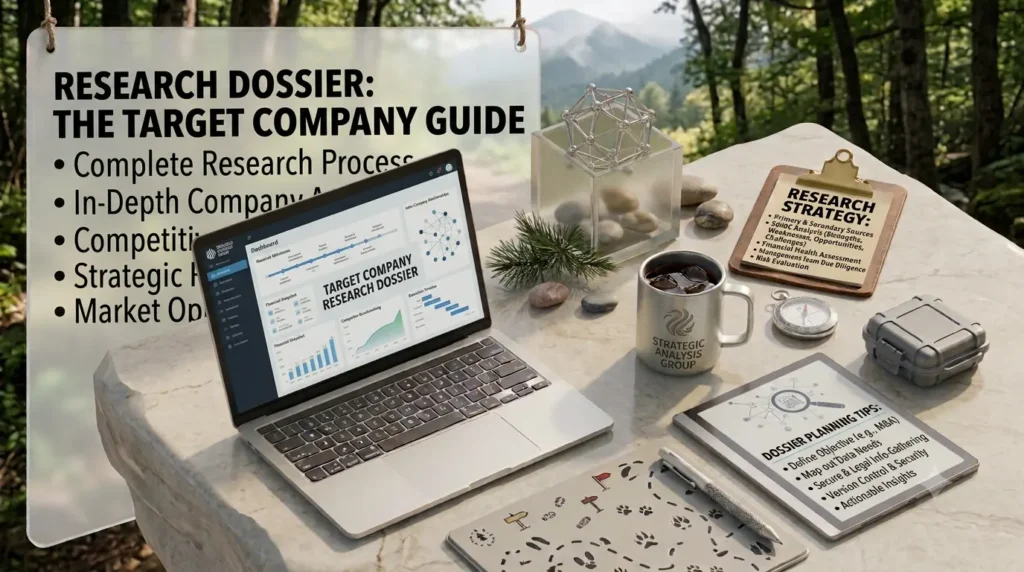
Research Dossier for Target Company: A Complete Guide to Company Research, Analysis and Planning.
Introduction
Before approaching a potential business partner, contacting a prospective client, investing in a company or studying a competitor, it is important to understand the organisation you are dealing with.
A company website may explain its services, products and background, but that information rarely provides the complete picture. You may also need to examine its industry, competitors, market position, business model, leadership, customer feedback and recent developments.
This is where a research dossier for a target company becomes useful.
A research dossier brings relevant information about an organisation together in one structured document. It helps individuals and businesses understand a company, identify opportunities, recognise potential risks and make decisions using organised research rather than assumptions.
For example, a marketing agency preparing to approach a potential client could create a dossier covering the company’s services, target audience, online presence, competitors and marketing opportunities. Similarly, an investor researching a business may need information about its financial position, ownership, industry and commercial risks.
In this guide, we will explain what a target company research dossier is, what information it should contain, how to prepare one, which sources to use and how to turn research findings into practical business decisions.
What Is a Research Dossier for a Target Company?
A research dossier for a target company is a structured collection of information, evidence and analysis about a specific business or organisation.
It is prepared to understand the company’s background, operations, products or services, market position, competitors, management, opportunities and potential challenges.
The term target company can refer to different organisations depending on the purpose of the research. It could be:
- A potential client you want to approach.
- A competitor you want to analyse.
- A supplier you are considering working with.
- A business partner you want to evaluate.
- A company you are considering investing in.
- An organisation being assessed for a merger or acquisition.
The contents of a dossier depend on the research objective. A sales team may focus on business needs and decision-makers, while an investor may require financial statements, ownership information and risk analysis.
A useful dossier does more than collect company details. It connects the available evidence to the questions the researcher wants to answer.
For example, knowing that a company offers digital marketing services is basic information. Understanding which industries it serves, how it positions its services, who its competitors are and where its market opportunities may exist provides more useful business insight.
Why Is a Target Company Research Dossier Important?
Researching an organisation before making a business decision can reduce uncertainty and help you prepare more effectively.
A structured dossier makes this process easier because relevant information is organised in one place.
Here are some important reasons to prepare one.
1. Understand the Company’s Business Model
A research dossier helps you understand what a company sells, who its customers are and how it generates revenue.
This information is important because two organisations operating in the same industry may have very different business models.
For example, one software company may sell monthly subscriptions, while another may generate revenue through one-time licences and implementation services.
Understanding this difference helps you evaluate the organisation in the right context.
2. Identify Business Opportunities
Company research can reveal areas where a business may need additional services, technology, partnerships or operational support.
Suppose a digital marketing agency is researching a potential client. The company’s website, service pages, content and online visibility may reveal opportunities to improve its search presence or lead generation.
These findings can help the agency prepare a relevant proposal instead of sending a generic sales message.
3. Analyse Competitors
Understanding a company also requires understanding the market in which it operates.
A dossier can include information about direct and indirect competitors, their services, pricing where publicly available, positioning and marketing activities.
This helps you identify what makes the target company different and where it may face competition.
4. Support Better Business Decisions
A structured research document helps decision-makers compare evidence before choosing a course of action.
For example, a business considering a new supplier can examine its background, product range, customer feedback and publicly available business information before moving forward.
Research cannot remove every uncertainty, but it can make the decision-making process more informed.
5. Prepare for Meetings and Business Discussions
A dossier can help sales teams, consultants, researchers and business development professionals prepare for conversations.
Instead of asking questions that are already answered on the company’s website, they can focus on more relevant topics, such as business challenges, future plans and potential areas of collaboration.
What Should a Target Company Research Dossier Include?
There is no single format that suits every research project. The information included should depend on the organisation and the reason for investigating it.
However, a practical company research dossier usually covers the following areas.
1. Company Overview and Background
Start with basic information that helps readers understand the organisation.
This section may include:
- Company name and official website.
- Year of establishment, where verified.
- Headquarters and operating locations.
- Industry and business category.
- Ownership type, where publicly available.
- Main products and services.
- Company mission and stated objectives.
- Parent company or subsidiaries, where relevant.
The purpose is to establish the company’s identity and provide context for the rest of the research.
Use official company pages, regulatory records and credible business sources to verify important details. Avoid treating information from an unverified directory as confirmed fact.
2. Products and Services Analysis
The next section should explain what the organisation offers.
Review its product pages, service descriptions, pricing information where publicly available, product demonstrations, brochures and other relevant material.
Consider questions such as:
- What are the company’s main products or services?
- Which problems do they aim to solve?
- Who is the intended customer?
- What features or benefits does the company highlight?
- Does it serve businesses, individual consumers or both?
- How does it position its offerings against alternatives?
For example, when researching a SaaS business, you might examine its software features, subscription plans, integrations, intended users and customer support options.
This section should describe what the company actually offers rather than making assumptions about its capabilities.
3. Target Audience and Customer Profile
Understanding a company’s customers can reveal a great deal about its business strategy.
Identify the audiences the organisation appears to serve and the problems its products or services address.
Depending on the business, this research may cover:
- Customer industries.
- Business size or consumer segments.
- Geographic markets.
- Common customer needs.
- Main use cases.
- Publicly identified customer organisations.
- Customer testimonials and case studies.
For a business-to-business company, its audience may include small businesses, enterprise organisations or specific professional sectors.
For a consumer brand, the relevant audience may be defined by product needs, location, interests or purchasing behaviour.
Clearly distinguish between customer groups the company explicitly identifies and audiences you infer from its products or marketing.
4. Industry and Market Analysis
A company does not operate in isolation. Its performance and opportunities can be influenced by market conditions, customer demand, regulation, technology and industry competition.
This section should explain the environment in which the target company operates.
Research areas may include:
- Industry structure and major segments.
- Current market developments.
- Customer demand and buying behaviour.
- Relevant technological changes.
- Regulatory considerations.
- Market opportunities.
- Industry challenges.
- Geographic market coverage.
Use credible industry reports, government publications, trade associations, research institutions and relevant business news.
If you include market size or growth figures, mention the source, publication date, geographic scope and methodology where available. Avoid presenting estimates as exact facts.
5. Competitor Analysis
Competitor research is an important part of understanding a target company.
It helps establish how the organisation compares with other businesses offering similar products or services.
Identify both direct and indirect competitors.
Direct competitors offer similar products or services to a similar audience.
Indirect competitors solve the same customer problem through a different product, service or approach.
Compare relevant factors such as:
| Research Area | What to Examine |
|---|---|
| Products and services | Main offerings and service categories |
| Target audience | Customer groups and industries served |
| Positioning | How each company presents its value |
| Pricing | Publicly available prices or pricing models |
| Website | Structure, content and user experience |
| Marketing | SEO, advertising, social media and content |
| Reputation | Public reviews, testimonials and feedback |
| Differentiation | Features or benefits that distinguish each business |
Do not assume that a company is better simply because it has more website traffic, followers or reviews. These indicators need context and may not reflect actual revenue or customer satisfaction.
The goal is to understand competitive differences, not just create a list of company names.
6. Leadership and Organisational Structure
Information about company leadership can help you understand the people responsible for strategic direction and business operations.
Where publicly available and relevant, research:
- Founders and co-founders.
- Directors and senior executives.
- Department heads.
- Board members.
- Parent and subsidiary relationships.
- Publicly announced leadership changes.
For a sales dossier, it may also be useful to identify the relevant department or business role involved in purchasing decisions.
However, do not confuse a person’s public job title with confirmed purchasing authority. Verify professional details through reliable company sources and public professional profiles.
7. Financial and Business Performance
Financial research helps establish how a company performs commercially, where relevant information is available.
For publicly listed companies, useful documents may include annual reports, quarterly results, income statements, balance sheets and cash flow statements.
Possible areas of analysis include:
- Revenue and revenue growth.
- Operating expenses.
- Profitability.
- Cash flow.
- Assets and liabilities.
- Debt levels.
- Business segments.
- Publicly disclosed funding.
- Financial risks.
For private companies, financial information may be limited or unavailable. Do not invent revenue, profit, employee numbers or valuation figures based on assumptions.
Clearly label estimates, third-party figures and management statements. If financial information cannot be verified, record it as unavailable rather than filling the gap with speculation.
8. Online Presence and Digital Marketing Analysis
For companies that depend on online visibility, digital research can be especially valuable.
Examine the organisation’s website, search presence, social media channels, content strategy and advertising activity where observable.
A digital marketing review may include:
- Website structure and usability.
- Search engine visibility.
- Important ranking keywords.
- Content quality and topical coverage.
- Technical SEO issues.
- Backlink profile.
- Local SEO presence, where relevant.
- Google Business Profile, where applicable.
- Social media activity.
- Publicly visible advertising.
- Lead-generation methods and calls to action.
For example, an SEO agency researching a potential client could compare the company’s website with competing businesses, identify content gaps and review its local search visibility.
These findings can help create a more relevant service proposal.
Remember that third-party SEO tools provide estimates, not guaranteed measurements of a company’s actual traffic, rankings or revenue.
9. Customer Reviews and Market Reputation
Public customer feedback can provide additional insight into how a company is perceived.
Look at relevant review platforms, testimonials, case studies, discussion forums and industry publications.
Consider:
- Common positive feedback.
- Repeated customer complaints.
- Product or service concerns.
- Customer support experiences.
- Delivery or fulfilment issues.
- Responses from the company.
A small number of reviews may not represent the full customer base. Check the dates, source, context and volume of feedback before drawing conclusions.
It is also important to distinguish between verified customer experiences, anonymous comments and promotional testimonials.
10. Recent News and Company Developments
A company’s recent activities can influence its priorities and business direction.
Check for announcements and developments such as:
- New product launches.
- Partnerships.
- Acquisitions.
- Funding announcements.
- Leadership changes.
- New market entry.
- Expansion plans.
- Regulatory developments.
- Publicly reported legal or operational issues.
Record publication dates and distinguish confirmed announcements from rumours or speculation.
Recent information is particularly useful when preparing for a meeting, evaluating a potential partnership or assessing a company in a changing industry.
11. Opportunities, Risks and Key Findings
The final analytical section should bring the research together.
Rather than repeating every detail, explain what the collected evidence means for the research objective.
For example, a dossier prepared for a potential client could identify:
Potential opportunities
- Relevant services the company may benefit from.
- Underserved customer segments.
- Gaps in its online content.
- Opportunities for partnerships.
- Markets it may be positioned to explore.
Potential risks
- Strong competition.
- Unclear business information.
- Negative patterns in public feedback.
- Dependence on a limited product range.
- Regulatory or operational challenges.
- Missing evidence about important claims.
Each finding should be connected to its supporting source or clearly labelled as an assessment.
How to Create a Research Dossier for a Target Company
Once you know what information to collect, the next step is to organise the research process.
The following workflow can help you prepare a useful dossier.
Step 1: Define the Purpose of Your Research
Before opening search engines or collecting company information, decide why you are researching the organisation.
Are you trying to:
- Find a potential client?
- Evaluate a competitor?
- Identify a business partner?
- Review a supplier?
- Assess an investment opportunity?
- Prepare for a business meeting?
Your objective determines which information matters most.
For example, a marketing agency researching a prospective client does not need the same level of financial analysis as an investment professional assessing an acquisition target.
Step 2: Identify the Target Company
Confirm the exact organisation you want to research.
Check its official name, website, operating country and relevant business entity. This is particularly important when multiple companies have similar names.
Also identify whether the target is publicly listed, privately owned, a subsidiary or part of a larger group.
The type of organisation can affect how much reliable information is publicly available.
Step 3: Collect Information From Multiple Sources
Start with the company’s official website and publicly available materials.
Then expand your research to independent sources such as:
- Government company registries.
- Regulatory filings.
- Annual reports.
- Industry publications.
- Reputable business news websites.
- Research institutions.
- Trade associations.
- Public professional profiles.
- Customer review platforms.
A university company-research guide from the University of Queensland recommends examining company status, financial information, news, industry conditions, competitors, websites and social media as part of a company research process.
Do not rely on a single source for important findings.
Step 4: Verify Important Information
Company information can be outdated, incomplete or inconsistent across different websites.
Check important facts against original or authoritative sources whenever possible.
For example, if a business directory lists a company’s headquarters, compare that information with the company’s official website or relevant public registration records.
For financial information, prioritise official filings and published reports over unsupported estimates.
Record the source and date for each important finding.
Step 5: Analyse the Findings
Collecting information is only one part of the process.
You must also interpret what the information means.
For example, finding that a company has several competitors is not enough. You should identify how those competitors differ, which customer groups they serve and what this could mean for the target organisation.
Use comparisons, evidence and clearly labelled observations to make your analysis useful.
Step 6: Organise the Dossier
Arrange your findings under clear sections, such as:
- Executive summary.
- Company background.
- Products and services.
- Target audience.
- Industry and market analysis.
- Competitor analysis.
- Leadership and structure.
- Financial information.
- Online presence.
- Reputation and recent developments.
- Opportunities and risks.
- Sources and research notes.
Keep the document easy to scan. Tables, short summaries and source links can make complex research more accessible.
Step 7: Prepare Recommendations and Next Steps
Conclude with practical recommendations based on the research objective.
For a potential sales prospect, this could mean identifying the most relevant service to propose and the business problem to discuss.
For competitor research, it could mean identifying gaps in your own positioning or areas that need further investigation.
For investment or acquisition research, it may mean recommending further specialist review rather than treating preliminary desk research as a final decision.
Best Sources and Tools for Company Research
The right sources depend on the target company’s location, size, ownership and industry.
A combination of official records, company materials and independent research usually provides a stronger foundation than relying on general search results alone.
Here are useful starting points.
| Source or Tool | How It Helps |
|---|---|
| Official company website | Background, products, services and announcements |
| Government company registries | Registered details and available corporate records |
| Annual reports | Financial and operational disclosures for reporting companies |
| Regulatory databases | Official filings and regulated disclosures |
| Public professional profiles, company updates and hiring activity | |
| Google News | Recent company and industry coverage |
| Industry reports | Market conditions, trends and sector analysis |
| Customer review platforms | Public customer feedback and reputation signals |
| SEO research tools | Estimated keyword visibility, backlinks and competitor activity |
| Business databases | Company profiles and other business information, depending on access |
For example, the U.S. Securities and Exchange Commission’s EDGAR database provides access to filings made by companies subject to its reporting requirements. It is relevant to U.S. reporting companies, not a universal registry for businesses in every country.
For Indian companies, relevant official information may be available through the Ministry of Corporate Affairs and other applicable regulatory sources. Access and disclosure depend on the company type and the records involved.
Research Dossier vs Company Profile vs Due Diligence
These terms are related, but they do not mean exactly the same thing.
| Aspect | Company Profile | Research Dossier | Due Diligence |
|---|---|---|---|
| Main purpose | Introduce a company | Investigate a company for a specific objective | Assess a transaction or business decision in depth |
| Information | Basic company details | Background, market, competitors, evidence and analysis | Detailed commercial, legal, financial and operational examination |
| Analysis | Usually limited | Depends on the research objective | More extensive and structured |
| Typical users | Customers, partners and general readers | Sales teams, analysts, consultants and business researchers | Investors, buyers, lenders and professional advisers |
| Outcome | Company overview | Findings, opportunities, risks and next steps | Evidence-based assessment for a significant decision |
A company profile is generally descriptive. It tells readers what an organisation does.
A research dossier goes further by collecting and analysing information relevant to a particular objective.
Due diligence is a more formal and often deeper process, particularly when a company is being considered for investment, acquisition, financing or another significant transaction.
A preliminary research dossier should not be presented as a substitute for professional financial, legal, tax or technical due diligence.
Common Mistakes to Avoid When Preparing a Company Research Dossier
Even a well-organised document can be misleading if the research process is weak.
Avoid these common mistakes.
1. Relying Only on the Company’s Website
Official websites are useful for understanding how a company describes itself. However, they may not provide independent information about its market position, financial performance or customer experience.
Use additional credible sources to develop a more balanced picture.
2. Using Outdated Information
Company details can change over time. Leadership, services, ownership, locations and financial performance may no longer match older reports.
Record publication dates and check whether important information is still current.
3. Treating Estimates as Confirmed Facts
Third-party platforms may estimate website traffic, revenue, employee numbers or market share.
Do not present these figures as verified company disclosures. Label estimates clearly and explain their limitations.
4. Ignoring Competitors
A company cannot be properly understood without considering the market around it.
Compare relevant competitors and industry alternatives rather than assessing the target organisation in isolation.
5. Collecting Information Without a Clear Objective
A long document is not necessarily a useful document.
Focus on information that helps answer the original research questions. Remove irrelevant details and summarise the findings that matter.
6. Failing to Record Sources
Every important claim should be traceable to a source.
Include source links, publication dates and access dates where useful. This makes it easier to verify findings and update the dossier later.
7. Confusing Research With Final Verification
Public information may be incomplete. A dossier can identify questions that need further investigation, but it cannot automatically confirm confidential business information or replace formal verification.
Be clear about what is known, what is estimated and what remains unverified.
Conclusion
A research dossier for a target company is a practical way to organise business information and turn it into useful analysis.
It can help you understand an organisation’s background, business model, products, customers, competitors, financial position, market environment and potential challenges.
The most effective dossiers begin with a clear research objective, use multiple reliable sources and distinguish verified facts from estimates and assumptions. They also explain what the findings mean rather than simply collecting company information.
Whether you are researching a potential client, studying a competitor, evaluating a supplier or preparing for a business opportunity, a structured dossier can help you approach the decision with better information and clearer next steps.
Remember that the depth of research should match the importance of the decision. For major investments, acquisitions or legal and financial commitments, preliminary company research should be followed by appropriate professional due diligence.
What is a research dossier for a target company?
A research dossier for a target company is a structured document containing information and analysis about a business. It may cover company background, products, services, customers, competitors, financial information, industry conditions, risks and opportunities.
What is the main purpose of a company research dossier?
Its main purpose is to help individuals and organisations understand a target company before making a business decision. It can support sales prospecting, competitor analysis, supplier evaluation, partnership research and investment preparation.
What information should a target company dossier include?
A typical dossier includes the company’s background, business model, products and services, target audience, industry, competitors, leadership, financial information where available, online presence, reputation, recent developments and potential risks.
How do I research a company before approaching it as a potential client?
Start by reviewing its website, services, target customers and industry. Then examine its competitors, online presence, recent announcements and potential business challenges. Use these findings to prepare a relevant and personalised approach.
Which tools can help with company research?
Useful resources include official company websites, government registries, regulatory databases, annual reports, LinkedIn, Google News, industry publications, business databases and SEO research tools. Choose sources according to the company and the purpose of your research.